
Consensus is how a blockchain decides who writes the next block – and how everyone else agrees it’s valid. Most people know the headline acts: Proof of Work (PoW) and Proof of Stake (PoS). But they’re not the only ways to coordinate a network.
As chains push for higher throughput, lower energy use, faster finality, and clearer on-chain governance, other approaches have stepped in: Proof of Authority (PoA), Delegated Proof of Stake (DPoS), and a range of hybrids that mix ideas to suit different risks and users. This piece walks through what’s changing and what it means if you build products, run infrastructure, or move money on-chain.
Consensus is an engineering choice. You’re deciding how much security you can fund, how validators are rewarded or penalized, and what you can operate reliably at scale.

What is a consensus mechanism in blockchain?
A consensus mechanism is the rulebook nodes use to agree on the ledger without a central authority. It orders transactions, locks in history (immutability), and prevents double-spends – even if some participants fail or act maliciously.
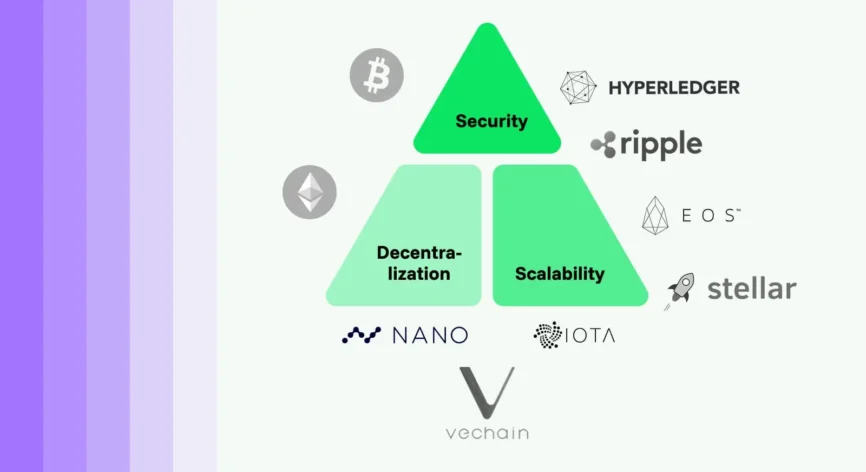
Most designs are trying to square the blockchain trilemma:
- Decentralization: open participation and no single party in control of validation.
- Scalability: the network processes more transactions, confirms them quickly, and keeps fees predictable under load.
- Security: strong resistance to attacks and Byzantine faults so finalized data stays immutable.
No system maximizes all three at once. Every chain picks a spot on that triangle – which is why new designs (and hybrids) keep appearing to rebalance those trade-offs for different use cases.
Proof of Work and Proof of Stake
Proof of Work, popularised by Bitcoin, and Proof of Stake, popularised by Ethereum post-merge in 2022, exemplify the two most common consensus mechanisms.
- PoW (mining): hash power competes to find a valid block. Security comes from energy expenditure and economic cost. Examples include Bitcoin and Litecoin.
- PoS (staking): validators lock stake, are pseudo-randomly selected to propose/attest blocks, and earn staking rewards while risking slashing for misbehavior. Examples include Ethereum and Cardano.
For a deeper explainer, see Proof of Work vs Proof of Stake.
At a glance
| Property | PoW | PoS |
|---|---|---|
| Energy use | High | Low |
| Transaction speed | Moderate | Higher (varies by design) |
| Finality | Probabilistic | Often faster, explicit finality layers |
| Security model | Economic via energy | Economic via stake |
| Hardware barrier | Specialized (ASIC/GPUs) | Commodity validator nodes |
As adoption grows, new designs address PoW/PoS limitations – enter PoA, DPoS, and hybrid models.
Proof of Authority (PoA): trusted validators for speed and efficiency
PoA meaning (proof of authority): a permissioned consensus model where a known, identity-vetted set of authority nodes produces blocks. Validators are approved up front – often by a governance committee – and their real-world identity or institutional reputation is part of the security model.
How it works
- A small, governed validator set takes turns proposing and finalizing blocks, usually with a BFT-style vote.
- Because the group is small and coordinated, confirmations are quick and finality is predictable.
- If a validator misbehaves, governance can remove its authority (and, in some variants, slash a posted bond).
Why teams choose it
- High throughput and low latency lead to low fees and smooth user experience.
- No mining means strong energy efficiency.
- The governance model is explicit, which suits permissioned and enterprise blockchain deployments that need clear accountability.
Trade-offs
- Less decentralization: trust concentrates in who selects and oversees validators.
- Higher risk of censorship or policy mistakes if the authority set is too small or poorly governed.
Where it fits
- Supply-chain traceability, data-sharing consortia, and private/consortium networks that need speed and auditability.
- Real-world examples include projects that use PoA or PoA-style variants for predictable performance (e.g., VeChain, POA Network; BNB Smart Chain runs a “staked authority” variant).
PoA exchanges some openness for operational guarantees and tight governance control – useful when business rules and accountability matter as much as raw decentralization.
Delegated Proof of Stake (DPoS): democracy in consensus
DPoS meaning: “delegated consensus.” Token holders vote to elect a limited number of block producers (often called delegates or witnesses). Those producers run the network on a schedule, and the community can rotate them out at any time – the validator election never really stops.
How it works
- Holders stake tokens and vote for their preferred delegates.
- The top N delegates produce blocks in short, fixed slots.
- Rewards (and, where supported, slashing/penalties) align incentives; many networks share a portion of rewards with voters.
Why teams choose it
- Fast block times and high throughput thanks to a compact, well-timed producer set.
- Community-driven governance with transparent competition among delegates.
- Lower hardware requirements for most participants; only delegates run the heavy infrastructure.
Risks to watch
- Voter apathy can entrench incumbents and reduce effective decentralization.
- Collusion or vote-buying among delegates.
- Governance capture if large custodians or exchanges control significant voting power.
Examples
- EOS, TRON, and earlier BitShares/Steem deployments showcase the DPoS blockchain pattern: speed and governance via elected producers.
DPoS vs PoS
- Validator selection: PoS selects validators by stake-weighted randomness; DPoS adds explicit community voting to elect a small producer set.
- Scalability: DPoS often runs faster due to fewer producers and tight slot scheduling.
- Governance: DPoS bakes governance into block production; PoS usually separates protocol governance from the consensus engine.
DPoS delivers speed and built-in governance, but it depends on active, informed voting to avoid centralization creep.
Hybrid consensus models: combining the best of multiple worlds
Hybrid designs blend two (or more) consensus methods to hit a sweeter spot on the security-scalability-decentralization triangle. Instead of betting on a single model, they split responsibilities – one layer might focus on raw security, another on governance or fast finality.
Common patterns
- PoW + PoS: Proof of Work handles open block creation, while Proof of Stake validates, finalizes, or governs upgrades (a Decred-style split).
- PoA + PoS: identity-vetted authorities produce blocks, and staking aligns incentives or broadens participation. You’ll see this in “staked authority” setups used by some enterprise or consortium chains (and BNB Smart Chain’s PoSA variant).
- PoW + PoA: a permissionless PoW base combined with authority checkpoints for specific workflows – useful when you need both open entry and operational guarantees for certain tasks.
Why mix?
- Scalability without throwing out security: push throughput and confirmation speed while keeping strong economic or identity-based assurances.
- Governance that’s actually workable: add clear processes for upgrades, validator rotation, and incident response – especially valuable for regulated or multi-stakeholder networks.
- Fit for different users: tune the consensus architecture so retail users, institutions, and infrastructure providers each get the guarantees they care about.
Challenges
- More moving parts: coordinating modules (ordering, finality, governance) adds complexity to implementation and operations.
- Explaining the threat model: you’ll need crisp documentation for auditors, regulators, and integrators so they understand where security comes from and when transactions are truly final.
Ultimately, hybrids are about dividing labor – letting one mechanism secure the base while another delivers speed or cleaner governance – so the network can meet real-world requirements without leaning too far to one side of the trilemma.
| Hybrid | What it blends | Typical outcome |
|---|---|---|
| PoW + PoS | Baseline security + stake governance/finality | Balanced security with adaptable governance |
| PoA + PoS | Identity-vetted validators + staking | Performance with wider economic alignment |
| PoW + PoA | Open entry + authority checkpoints | Operational certainty for specific workflows |
Beyond PoA and DPoS: the new wave of consensus innovation
After PoA and DPoS, a new set of ideas is pushing the frontier. These models try different angles on the trilemma, especially faster ordering and greener security budgets.
- Proof of History (PoH): a cryptographic clock that timestamps events, so nodes can order transactions before running full consensus. It helps high-throughput networks keep short block times and steady pipelines.
- Proof of Space and Time (PoST): exchanges heavy compute for storage commitments plus verifiable time. It targets sustainable consensus with lower energy use and broad access to hardware.
- Proof of burn, capacity, reputation: niche designs that rely on sunk economic cost, disk capacity, or validator reputation to align incentives where classic staking or mining is not ideal.
The direction of travel is likely modular blockchains. Instead of one mechanism doing everything, the system splits into roles (ordering, data availability, execution, and finality) so each part can use the consensus approach that fits it best.
A payments stack might accept transactions through a very fast ordering layer, then hand them to a separate BFT-style finality layer to make them irreversible. A data-heavy network might prioritise strong availability proofs while keeping execution lightweight. The result is more flexible, domain-specific consensus stacks that are easier to tune than a single, all-purpose design.
Business and developer implications
Consensus touches the things users notice first: fee stability, confirmation time, and reliability. It also determines what your ops, compliance, and security teams must account for.
- Performance and UX: Consensus sets latency and transaction finality, which drive checkout success rates, refund policies, and support playbooks. For payout workflows at scale, see Mass crypto payouts.
- Energy and Sustainability: PoS, PoA, DPoS, and PoST are generally more energy-efficient than PoW, which helps with sustainability targets and public reporting. If “green blockchain” is part of your brand, these models support it.
- Governance and Compliance: Clear blockchain governance reduces audit friction: who can validate, how validators are elected or removed, what constitutes finality, and how incidents are handled. Permissioned and hybrid blockchain setups often win here because roles and escalation paths are explicit.
- Security trade-offs: Smaller validator sets raise throughput but increase collusion and censorship risk. Larger sets improve fault tolerance and censorship resistance but can slow things down. Hybrids let you calibrate both by separating ordering from finality or by using stake plus identity.
- Integration: Payments, custody, and treasury systems need predictable confirmation rules and a clear view of reorg risk. Asset support also matters in practice; check coverage on Supported coins before you commit a roadmap.
Choosing a model
- Open networks with broad participation: PoS or PoS-centric hybrids for decentralization with workable throughput.
- Enterprise or consortium workflows: PoA or PoA+PoS for speed, auditability, and defined accountability.
- Sustainability focus: PoS, PoST, or delegated consensus with low energy budgets.
- High-frequency apps: mechanisms with deterministic scheduling and fast finality, for example DPoS or PoA variants, sometimes paired with a separate finality layer.
Pick the consensus that matches your risk model, throughput goals, and governance needs, then document finality and failure modes so product, finance, and compliance can operate confidently.
Wrapping up – the evolution path of blockchain consensus
Consensus started with PoW’s energy-backed security, moved toward PoS for better scalability and sustainability, and then branched into PoA and DPoS to add speed and clearer governance. Hybrid designs tie these ideas together, while newer approaches experiment with time, space, and modular stacks where ordering, availability, execution, and finality are handled by different components.
There is no one “best” mechanism. The right choice depends on context: how much decentralization you need, the throughput your users expect, the security model your regulators and auditors accept, and the level of operational trust your business can support.
As networks take on more real-world workloads, consensus remains the core technology that turns a set of nodes into a reliable system.
Frequently Asked Questions (FAQ)
What are the main blockchain consensus mechanisms?
PoW, PoS, PoA, DPoS, and hybrid combinations. Newer approaches include PoH and PoST. Each balances security, decentralization, and speed differently.
How does DPoS differ from PoS?
PoS randomly selects validators proportional to stake; DPoS adds token-holder voting to elect a small set of delegates who produce blocks. Results: faster scheduling, stronger on-chain governance, higher centralization risk.
Is Proof of Authority centralized?
It’s permissioned and identity-based, so decentralization is limited by design. The benefit is predictable performance and clear accountability for enterprise and consortium use cases.
What is a hybrid consensus model?
A design that mixes mechanisms (e.g., PoW+PoS, PoA+PoS) to blend security, governance, and throughput. Useful when different stakeholders require different assurances.
Which consensus mechanism is best for business applications?
It depends on requirements. For open networks and broad reach, PoS-style systems are common. For internal or regulated workflows needing fast finality and clear control, PoA or PoA+PoS is typical.
For payouts and asset coverage considerations, review your network list: Supported coins and payout needs.