The comparison between Bitcoin vs Bitcoin Cash exists because both networks come from the same original blockchain, but they follow different approaches. Bitcoin Cash was created in 2017 as a result of a hard fork bitcoin event, when part of the community disagreed on how Bitcoin should scale.
The core issue was how to keep transactions fast and affordable as usage increased. One group believed Bitcoin should remain conservative, with limited block space and additional scaling layers. Another group believed the network should increase the block size limit and keep most activity on the main chain. This disagreement led to the creation of Bitcoin Cash (BCH), while the original network continued as Bitcoin (BTC).
Today, this split reflects two different priorities. Bitcoin focuses on security, decentralization, and its role as a store of value. Bitcoin Cash focuses on fast, low-cost peer-to-peer payments and its role as digital cash.
This guide explains the bitcoin vs bitcoin cash difference, including technology, speed, mining, and real-world use cases
What is Bitcoin (BTC)?
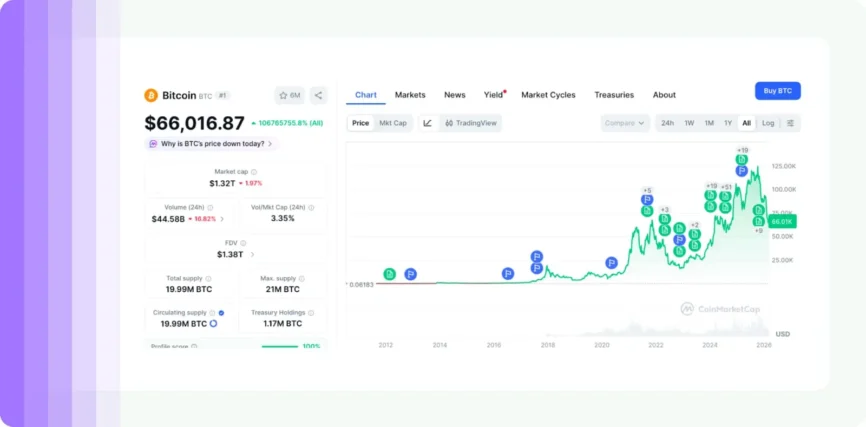
Bitcoin is the original proof-of-work blockchain launched in 2009. It allows users to send and receive value without relying on banks or central authorities. Its native asset, BTC, is widely known as the first cryptocurrency and remains the largest by market value.
Bitcoin’s design emphasizes security and stability. Transactions are recorded on a public ledger and confirmed by miners. New blocks are added approximately every 10 minutes, and each confirmation strengthens the security of the transaction.
Bitcoin also has a limited supply of 21 million coins. This fixed supply is one reason why Bitcoin is often described as digital gold. Many users hold BTC as a long-term asset rather than using it for frequent payments.
Because block space is limited, transaction fees can increase during periods of high demand. This reflects Bitcoin’s current role as a secure settlement network and store of value.
What is Bitcoin Cash (BCH)?
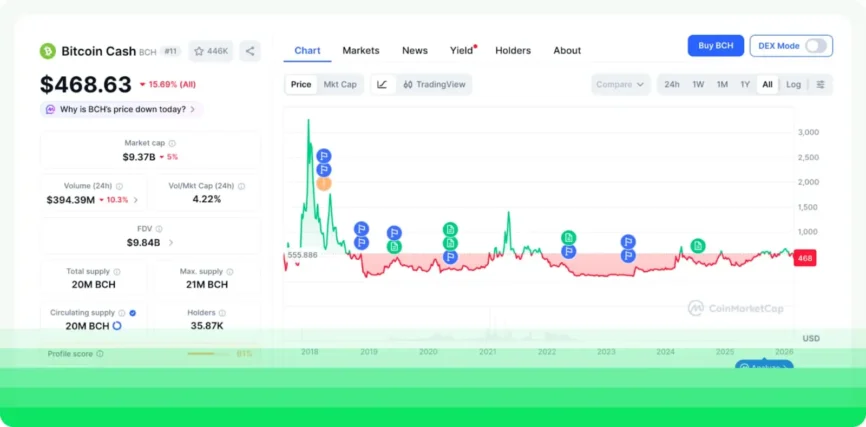
Bitcoin Cash is a separate blockchain that was created from Bitcoin in 2017. It shares the same original code and uses the same mining algorithm, but it introduced key changes to improve transaction efficiency.
The main difference is the block size limit. Bitcoin Cash allows much larger blocks than Bitcoin. This means more transactions can be processed in each block, which helps keep fees low and improves transaction speed.
The goal of Bitcoin Cash is to function as digital cash for everyday use. It is designed to support peer-to-peer payments that are fast and inexpensive, making it more practical for purchases, transfers, and small payments.
Like Bitcoin, Bitcoin Cash operates as a decentralized proof-of-work blockchain and does not rely on central control.
Bitcoin Cash vs Bitcoin: technical comparison
The main technical difference between BTC vs BCH is how each network handles scaling and transaction capacity.
Bitcoin maintains stricter limits on block capacity. This helps keep the network more decentralized and secure, but it also means fewer transactions can fit into each block. When demand is high, this can lead to slower confirmation times and higher crypto transaction fees.
Bitcoin Cash increased the block size limit to allow more transactions per block. This improves transaction throughput and usually keeps fees lower. As a result, Bitcoin Cash can process more payments directly on the main blockchain.
Both networks use the same proof-of-work blockchain model and the same SHA-256 mining algorithm. However, their scaling strategies differ. Bitcoin focuses on long-term security and layered scaling solutions, while Bitcoin Cash focuses on higher on-chain capacity.
This difference reflects the original bitcoin scaling debate and remains the defining distinction between the two networks.
Use cases: Bitcoin vs Bitcoin Cash
Bitcoin and Bitcoin Cash are used differently because of their design priorities.
- Bitcoin is mainly used as a store of value and settlement asset. Many users buy and hold BTC as a long-term investment. It is also used for large transfers, treasury holdings, and institutional exposure to digital assets.
- Bitcoin Cash is more focused on payments. Its lower fees and faster on-chain processing make it suitable for peer-to-peer payments, retail transactions, and transfers where cost efficiency matters. It is often used for smaller payments that would be less practical on Bitcoin during periods of high fees.
Both assets can be accepted by businesses as payment. Supporting both BTC and BCH allows merchants to serve customers who prefer different payment methods while benefiting from blockchain settlement.
Bitcoin and Bitcoin Cash serve different roles, but both are valuable for businesses. Bitcoin is widely recognized and trusted as a digital asset, while Bitcoin Cash offers faster and lower-cost payments. With CryptoProcessing.com, merchants can accept both through a single integration and receive clear, reliable settlement.

Mining Bitcoin vs Bitcoin Cash
Bitcoin and Bitcoin Cash use the same mining algorithm, called SHA-256. This means the same hardware can mine both networks. However, mining conditions differ because each network has its own hash rate, network difficulty, and economic incentives.
- Bitcoin has a much higher hash rate than Bitcoin Cash. This means more computing power secures the Bitcoin network. A higher hash rate increases security, because it makes attacks more expensive and difficult. It also reflects Bitcoin’s larger market size and stronger mining participation.
- Bitcoin Cash has a lower total hash rate, but it adjusts mining difficulty more quickly. This allows the network to maintain stable block production even when mining power moves between BTC and BCH. For miners, profitability depends on several factors, including coin price, mining difficulty, and transaction fees.
In practice, most industrial mining operations focus primarily on Bitcoin due to its stronger market demand and more stable mining rewards. However, Bitcoin Cash remains compatible with the same infrastructure, which allows miners to switch between networks when conditions change.
Bitcoin vs Bitcoin Cash: security and decentralization
Security and decentralization are critical features of any proof-of-work blockchain. Both Bitcoin and Bitcoin Cash rely on miners and nodes to validate transactions and maintain the network.
Bitcoin’s strongest advantage is its size. It has the largest hash rate and the widest global network of nodes. This makes it the most secure cryptocurrency network today. Attacking the Bitcoin network would require enormous computing resources, which makes such attacks highly impractical.
Bitcoin Cash uses the same security model but operates with lower total mining power. While it remains secure in practice, its lower hash rate means the theoretical cost of attacking the network is lower than Bitcoin’s. This is one of the trade-offs of its design.
However, Bitcoin Cash’s larger blocks allow faster transaction processing and lower fees, which improves usability for payments. The trade-off between maximum security and transaction efficiency reflects the different priorities of the two networks.
Bitcoin Cash vs Bitcoin: a technical comparison chart
The following table summarizes the main technical differences between BTC and BCH:
| Category | Bitcoin (BTC) | Bitcoin Cash (BCH) |
|---|---|---|
| Launch year | 2009 | 2017 (fork of Bitcoin) |
| Blockchain type | Proof-of-work blockchain | Proof-of-work blockchain |
| Block size limit | Smaller, more restrictive | Larger (up to 32 MB) |
| Transaction fees | Can be higher during congestion | Usually lower |
| Transaction capacity | Lower on-chain capacity | Higher on-chain capacity |
| Scaling approach | Conservative base layer + additional scaling layers | Larger blocks for direct scaling |
| Main use case | Store of value and settlement | Peer-to-peer payments |
| Hash rate | Very high | Lower than Bitcoin |
| Mining algorithm | SHA-256 | SHA-256 (same as Bitcoin) |
This bitcoin vs bitcoin cash chart shows that the core difference is scaling strategy. Bitcoin prioritizes maximum security and long-term stability, while Bitcoin Cash prioritizes transaction efficiency and lower fees.
Final thoughts
Bitcoin and Bitcoin Cash share the same origin, but they serve different purposes today.
- Bitcoin is the most secure and widely adopted cryptocurrency. Its limited supply, strong hash rate, and global recognition make it the leading store of value in the digital asset market. It is often used for long-term holding and large-value transfers.
- Bitcoin Cash focuses on fast and low-cost payments. Its larger block size allows more transactions per block, which keeps fees lower and improves usability for everyday payments.
The choice between Bitcoin and Bitcoin Cash depends on the use case. Bitcoin is better suited for saving, investing, and secure settlement. Bitcoin Cash is better suited for spending, transfers, and payment efficiency.
For businesses, accepting both can provide flexibility. Bitcoin offers strong brand recognition and trust, while Bitcoin Cash offers faster and cheaper transactions.
FAQ
What is the difference between Bitcoin and Bitcoin Cash?
Bitcoin and Bitcoin Cash are separate blockchains that share the same origin. Bitcoin focuses on security and its role as a store of value, while Bitcoin Cash focuses on faster and cheaper peer-to-peer payments. The main technical difference is the block size limit, which is larger in Bitcoin Cash to allow more transactions per block.
Is Bitcoin Cash faster than Bitcoin?
Bitcoin Cash can process more transactions per block because of its larger block size. This usually results in lower fees and faster practical confirmation during normal network conditions. However, both networks produce blocks on a similar schedule, and actual speed can vary depending on network usage.
Why was Bitcoin Cash created?
Bitcoin Cash was created in 2017 through a hard fork bitcoin event. The split happened because part of the community wanted to increase the block size limit to improve transaction speed and reduce fees. The goal was to preserve the original idea of Bitcoin as digital cash for everyday payments.
Can you use BCH like regular money?
Yes. Bitcoin Cash was designed to function as digital cash. It can be used for peer-to-peer payments, retail purchases, and transfers. Many businesses accept BCH as payment, and payment processors like CryptoProcessing.com allow merchants to accept BCH alongside other cryptocurrencies.
Which is better for mining: BTC or BCH?
Bitcoin is generally more profitable to mine because it has a higher market value and larger mining ecosystem. However, both BTC and BCH use the same SHA-256 algorithm, so miners can switch between them depending on mining difficulty, price, and profitability conditions.