

Managing crypto deposits and withdrawals at scale means coordinating different payment states. Businesses need a reliable record of each payment, rules for when funds become available, and a withdrawal process that can recover from interruptions without paying twice. Automation should move routine transactions through those controls and give people enough evidence to resolve exceptions.
This guide explains how to build that operating model across deposits, conversion, payout liquidity and reconciliation. The workflows below are design recommendations; a provider’s exact statuses, supported networks and contractual terms determine how they are implemented.
Why high volume crypto payments become difficult to manage
Volume exposes gaps between systems. A blockchain records a transfer, the processor assigns a payment status, the business updates a customer balance, and finance records the resulting movement. These events can occur at different times. A wallet alone cannot explain whether an incoming transfer belongs to an order, whether a balance is available for withdrawal or whether a payout still needs approval.
Multiple networks add another dimension. Supporting an asset does not mean supporting it on every blockchain. Confirmation rules, fee requirements and address formats differ, while congestion can affect one route without affecting another. Bitcoin’s developer documentation, for example, distinguishes a broadcast transaction from one included in a block and explains why confirmation policy matters.
The operational bottleneck is often the handoff: unmatched deposits, callbacks that were not processed, withdrawals waiting for funds, or completed transfers missing from the ledger. Start by identifying which event advances each payment and which team owns it when that event does not arrive.
How do enterprise crypto deposit and withdrawal workflows operate
Most businesses use a common transaction record to connect incoming payments with subsequent balance movements. Keep the original business reference alongside the provider’s identifiers, the asset and network, amounts, fees and timestamps. Record blockchain transaction identifiers when available; a single transaction can contain multiple transfers, so matching may also need an output or transfer-level identifier.
The lifecycle normally includes these activities:
- Create a payment request or deposit instruction. Associate it with the correct customer or order and show the supported asset, network, address and any required memo or tag.
- Detect and assess the deposit. Track the transfer, apply the relevant confirmation policy and complete required screening. A detected payment should remain pending until the applicable release conditions are met.
- Update balances and convert where required. Record the original receipt and any conversion as separate movements, including the executed rate and charges.
- Validate and release withdrawals. Check the recipient details, permissions, limits and available funds before submitting the payout.
- Track completion and reconcile. Follow the outgoing transaction to its documented completion state and match the records, including fees and any exceptions.
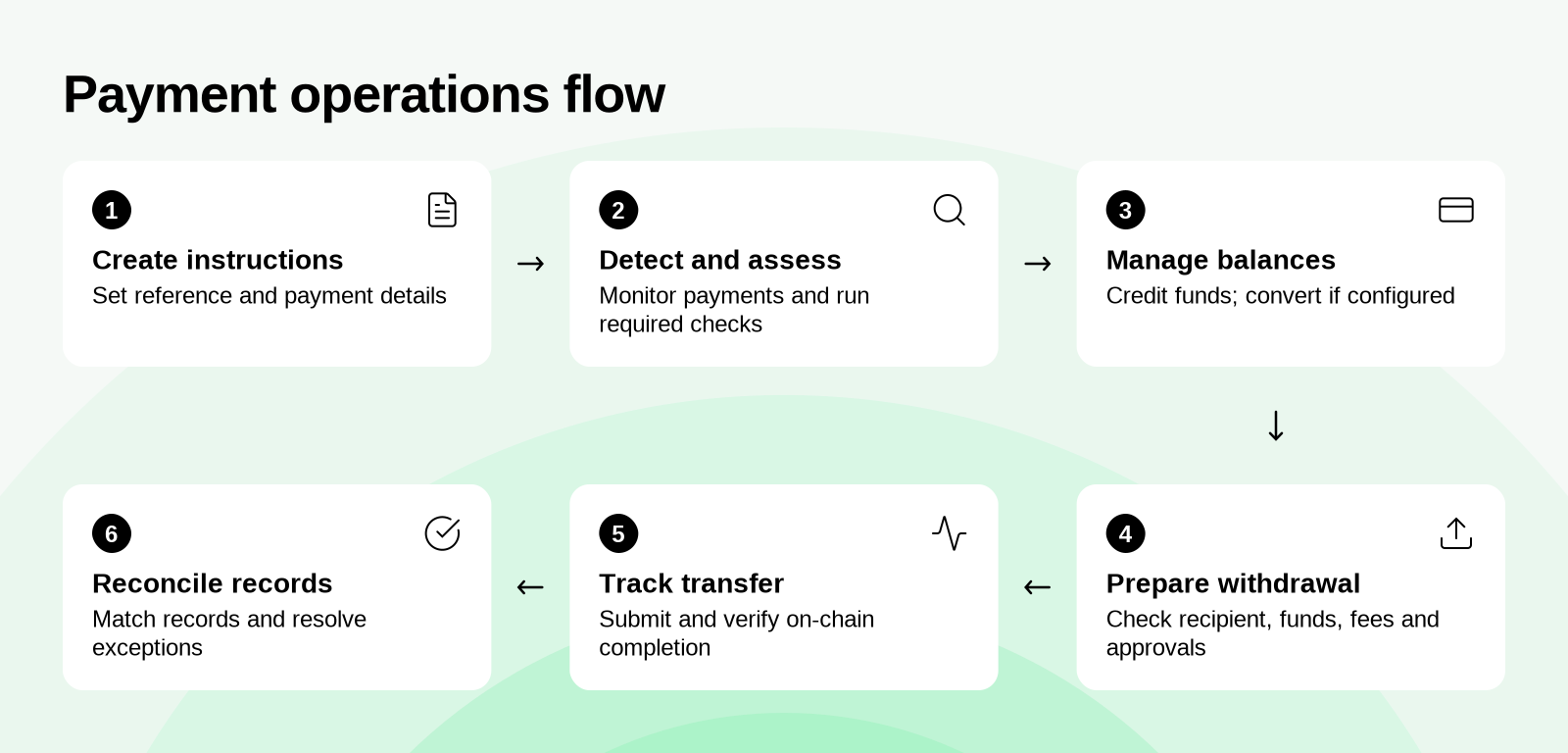
Payment screening can occur at several stages, rather than at one universal point. Conversion can also happen at different stages depending on the product and configuration. A merchant balance credit, an on-chain confirmation and money arriving in a bank account are separate events; define which one a status such as “settled” actually means.
How to automate crypto deposits across wallets and networks
Make every deposit attributable
Maintain a durable mapping between each deposit instruction and its customer or order. Unique addresses can simplify attribution where the provider supports them. A reusable customer address may suit account funding, but it still needs a record of each individual deposit. Do not assign an old address to a new customer simply because an earlier payment request expired.
Treat the network as part of the payment instruction. Store required memos or destination tags alongside the address, and validate the supported asset and network combination before displaying it. An address that looks valid does not establish that the receiving platform supports the transfer.
Where your business controls multiple wallets, keep an inventory of their purpose and access permissions. Plan how funds will move from deposit wallets into payout liquidity, including the fees and approvals those transfers require. Avoid adding wallets without a clear attribution or treasury purpose.
Separate detection from crediting
Define when an incoming transaction is merely visible and when it can support a customer credit. Follow the provider’s documented completion rules and your risk policy. Do not impose one confirmation threshold across unrelated networks or assume that a provider’s “confirmed” label always describes the same blockchain event.
Route underpayments, overpayments, expired requests and unexpected assets into explicit exception states. Define what happens to a late deposit before one arrives. A missing match should create an investigation, not an automatic credit to whichever order appears closest in value.
Make webhook processing recoverable
A crypto deposits API can help create and identify payment instructions; webhooks notify the business when their status changes. CryptoProcessing’s developer integration guide introduces these integration patterns. At scale, the additional task is making event handling reliable.
Design the receiving system to authenticate callbacks using the provider’s documented method, record accepted events durably and process them through a queue. Make balance updates idempotent: receiving the same event again must not create another customer credit. Check valid state transitions so a delayed pending event cannot overwrite a completed payment.
Do not rely solely on the next webhook arriving. Schedule status checks or reconciliation to find records that have stopped progressing, using the provider’s supported retrieval method and rate limits. Test duplicate events, delayed delivery and service restarts before increasing traffic.
How to process crypto withdrawals and mass payouts
Validate and reserve before submission
Give every withdrawal request a stable business identifier. Validate the recipient’s address, asset, network and required memo or tag, then apply account limits and approval rules. Address validation checks format and compatibility; it does not prove who controls an address or that a transfer is legally permitted.
Reserve the amount and applicable charges in your internal ledger when a request becomes eligible for processing. Make the reservation atomic so concurrent requests cannot spend the same available balance. Keep pending obligations separate from completed debits and release reservations only after the outcome is established.
Changes to saved recipients deserve their own controls. Where supported, use address allowlists and a separate approval for sensitive changes. The person maintaining recipient details should not automatically have unrestricted authority to release funds.
Process batches as individual obligations
Crypto mass payouts group outgoing instructions into a manageable submission or operating process. They do not necessarily combine every recipient into one blockchain transaction, and acceptance of a batch does not prove that every item succeeded.
Maintain a batch identifier and an individual record for each recipient payment. Apply documented batch-size and rate limits, check funding before release, and retain item-level outcomes. A queue should distinguish transactions waiting for approval from those waiting for liquidity or blockchain confirmation; adding workers will not resolve every kind of delay.
Check out the mass payout walkthrough to find more examples of setting up batch crypto payments.
Retry only after establishing what happened
An API timeout is an unknown outcome, not proof that the withdrawal failed. Query the original request using its retained identifiers before sending another. Use documented idempotency support where available; do not assume that an arbitrary reference field prevents duplicate payouts.
If a batch partly fails, isolate the unsuccessful items, resolve their causes and verify that they are safe to resubmit. Never replay a whole batch just because its overall status shows an error. Instead, export unsuccessful items and run them separately.
For a transaction already broadcast, check its network status and the provider’s recovery procedure. Do not create a second transfer simply because the first has taken longer than expected. A compliance hold also needs a compliance decision, not an automated retry loop.
What causes delays and failed payments
Investigate the last verified event. If the provider has not accepted the request, examine validation and connectivity. If a transaction is already on-chain, investigate execution and confirmation. If the provider shows completion but the business balance is wrong, examine event handling and reconciliation.
| Problem | Possible cause | Business impact | Recommended response |
|---|---|---|---|
| Deposit remains pending | Network congestion or confirmation policy | Customer credit is delayed | Check the transaction and required completion conditions; show an accurate pending status. |
| Deposit cannot be matched | Wrong network, missing tag or stale mapping | Funds are not credited correctly | Investigate with the provider; do not promise recovery or guess the customer match. |
| Withdrawal cannot start | Insufficient spendable balance or fee funding | Payout queue grows | Check reserves and fund the required asset and network through approved routes. |
| Submission times out | API or connectivity interruption | Outcome is uncertain | Retrieve the original request before considering resubmission. |
| Application status is stale | Missed, duplicate or out-of-order event | Customer and finance records disagree | Authenticate, deduplicate and replay events safely; reconcile against provider records. |
| Transfer waits on-chain | Fee conditions or network congestion | Recipient completion is delayed | Follow the network and provider’s supported recovery procedure. |
| Request is held | Screening alert, missing information or approval | Funds cannot be released yet | Route to the authorised owner and retain the decision trail. |
Better payment infrastructure can improve tracking, validation and recovery. It cannot guarantee a blockchain’s inclusion time or make an unsupported transfer recoverable.
How to coordinate liquidity and settlement
Plan payout liquidity by asset, network and legal entity. A total displayed balance can conceal funds that are pending, reserved or unavailable on the required route. Incoming payments may be processed correctly while withdrawals still lack usable funding.
Set a funding policy around expected withdrawals during the time needed to replenish balances. Include existing commitments, fee reserves and a buffer based on observed demand and replenishment delays. Review that buffer after incidents and seasonal peaks, rather than copying a universal percentage.
Conversion rules should reflect outgoing obligations. Converting every deposit to fiat may suit one treasury policy but leave a crypto payout operation needing another conversion. Record conversion costs separately and confirm when the resulting asset becomes spendable. Bank settlement has its own timing and conditions.
For self-managed Ethereum wallets, ETH is needed to pay network gas even when the transfer involves another token. Stablecoins also retain issuer, liquidity and other risks; do not treat their balances as equivalent to insured bank deposits.
Security and compliance controls for high-volume transactions
Control who can move funds
Separate permissions for viewing records, creating withdrawals, approving payments and changing security settings. Protect API secrets in managed secret storage, restrict their scope where supported, and rotate or revoke them under a documented process. Keep production credentials out of application logs and client-side code.
Set withdrawal limits and approvals according to the business’s exposure. Document who controls signing keys, how operational wallets are funded and what happens if an account or credential is compromised. For a managed service, establish the division of responsibility rather than assuming the provider handles every control.
Monitoring should cover unusual destinations, sudden withdrawal bursts, configuration changes and failed access attempts. Give authorised staff a way to pause outgoing processing and an escalation route that works outside office hours. Logs should identify the request, the decision and the actor without exposing secrets or unnecessary personal data.
Design compliance into the release conditions
Applicable obligations depend on the business model, operating entity, counterparties and jurisdictions. A merchant accepting payment is not automatically subject to the same obligations as a regulated virtual asset service provider. Determine the requirements for each role before choosing controls.
Where required, workflows must support KYB or KYC, AML monitoring, sanctions checks, geographic restrictions and suspicious-activity escalation. FATF’s virtual-asset guidance describes a risk-based approach and the secure exchange of originator and beneficiary information under the Travel Rule.
OFAC’s virtual-currency guidance makes clear that relevant US sanctions obligations apply to virtual-currency transactions as well as traditional currency. Its recommended approach includes risk assessment, screening and controls tailored to the business. Address screening or a blockchain analytics score alone does not establish that a transaction is compliant, so work together with your payment provider to comply with guidance applicable to your jurisdiction.
How to scale without matching every payment with manual work
Build the routine path around events and reserve human attention for exceptions. A useful exception record contains the last verified status, relevant identifiers, the amount at risk, the next permitted action and a named owner. Route funding shortages to treasury and screening alerts to compliance, rather than sending every stalled payment to one support queue.
Measure the age of pending items as well as their number. Separate time waiting for internal approval from time awaiting provider processing or network confirmation. Track manual interventions per completed transaction, callback processing lag, payout completion times and unreconciled amounts. These measures help locate the work that is growing with volume.
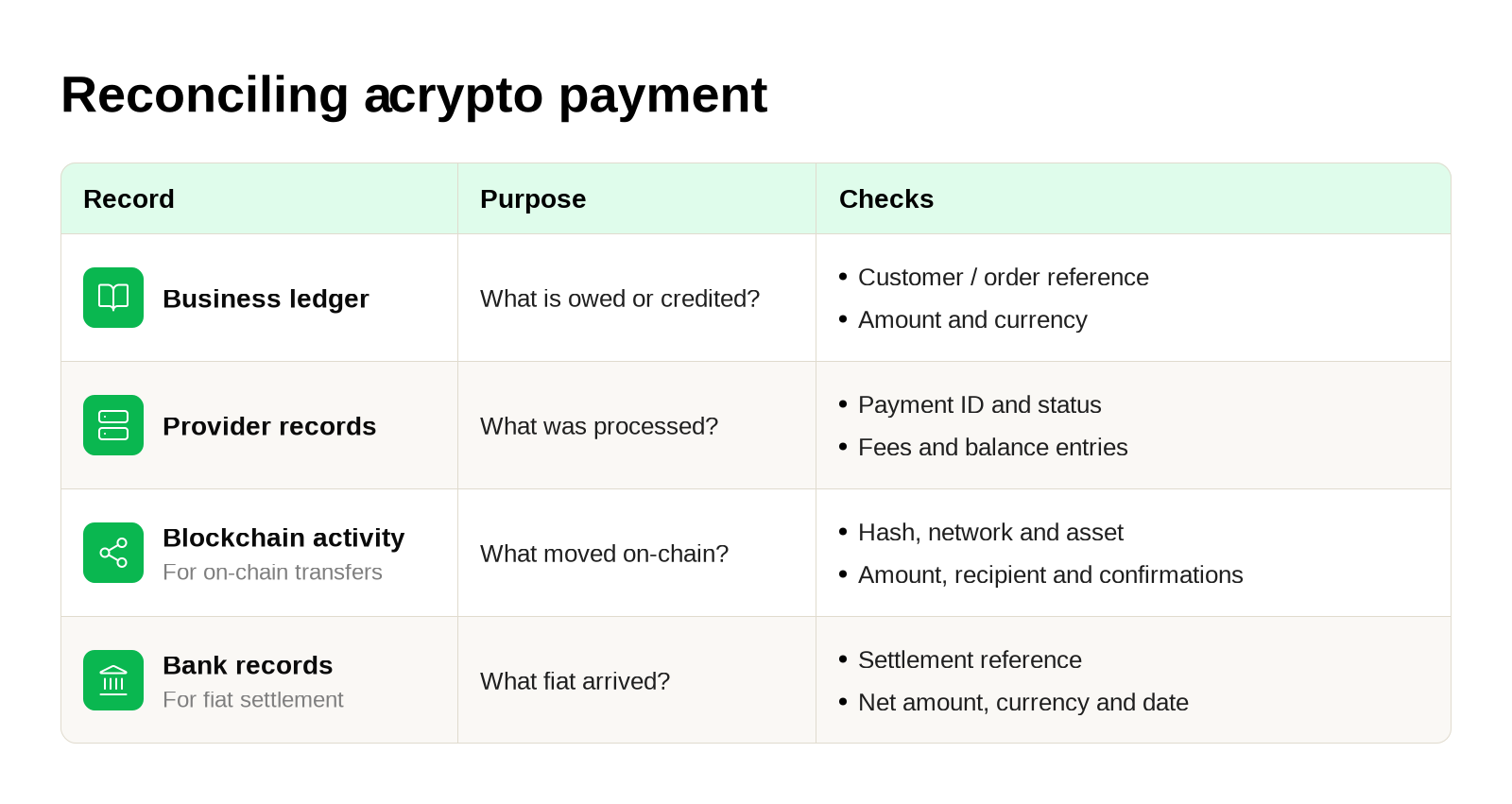
Reconcile the internal ledger against provider records and available blockchain evidence, then bank records where fiat settlement is involved. Preserve gross amounts, fees, conversion proceeds and net receipts as distinct entries. Avoid comparing balances without accounting for pending movements and the time each record was produced.
Before a volume increase, test interrupted submissions, duplicate events, low balances and partial batch failures. Agree realistic load and recovery tests with the provider. The goal is to demonstrate that transactions remain accounted for during failures, not simply that the API accepts a burst of requests.
What enterprises should require from payment infrastructure
Evaluate a provider against your actual incoming and outgoing routes. An asset list is only the beginning: verify supported networks, recipient requirements, conversion routes and which operator supplies each service.
Ask for evidence of how the infrastructure handles the difficult cases. Can your team retrieve a transaction after an interrupted submission? Are webhook authentication and retry behaviour documented? Can finance export sufficient records to explain a balance? Are payout limits, funding responsibilities and incident escalation terms explicit?
Test expected peaks, including the work generated by status updates and reconciliation. Assess the ability to recover after an outage alongside normal throughput. For broader due diligence, CryptoProcessing’s guide to choosing a crypto payment provider covers custody, compliance, settlement and total cost. No feature checklist substitutes for checking the contracting entity and current service availability.
How CryptoProcessing supports high volume deposits and payouts
CryptoProcessing’s payment gateway API documentation helps developers with incoming payment integration, status notifications, conversion and outgoing payment workflows. Mass Crypto Payouts further automate transaction batching and related automation.
A Crypto Business Account is set up for businesses to manage transaction history, exportable reports and account controls. Before integration, take a look at the CryptoProcessing Legal Hub to confirm availability in your jurisdiction. Product descriptions are informational and do not establish service eligibility in specific markets.
High-volume crypto deposit and withdrawal checklist
Setup
Define supported assets, networks and required memos/tags.
Verify provider capacity and recovery against agreed limits.
Keep access controls, compliance decisions and changes auditable.
Deposits
Match every deposit, including repeats, to a customer or order.
Separate detection, confirmation, review and balance credit.
Authenticate events, prevent duplicate processing and recover missed updates.
Withdrawals
Validate and approve withdrawals; keep each route funded, including fees.
Track each payout item and investigate unknown outcomes before retrying.
Reconciliation
Record conversion, settlement and bank receipt separately where applicable.
Reconcile each payment, including batch items, with external records and explain differences.
Summary: Building scalable crypto payment operations
Reliable scale comes from knowing where each payment stands and what can happen next. A deposit should create the correct credit once. A withdrawal should consume the correct available funds once. Every exception should remain visible until it is resolved and reconciled.
Build those rules into the integration, treasury policy and approval process before increasing volume. Payment infrastructure then has a clear job: support the business’s documented lifecycle, while preserving the evidence needed to account for every movement.
FAQ
How do businesses manage large volumes of crypto deposits and withdrawals?
They connect payment instructions, provider events and internal ledger entries through stable identifiers. Automated status handling processes routine transactions, while queues route funding, technical and compliance exceptions to their owners.
Can crypto deposits and withdrawals be automated?
Yes, where the provider supports the required APIs and event notifications. Automation still needs validation, duplicate prevention, funding checks and reconciliation. Some transactions must wait for an approval or compliance decision.
Which crypto payment processors offer deposit and withdrawal APIs?
CryptoProcessing provides APIs covering deposits and withdrawals. This article does not rank providers. For any candidate, verify the exact asset and network routes, transaction retrieval methods and service availability for the relevant entity and account.
How do mass crypto payouts work?
A business submits multiple recipient instructions through a supported API or file workflow. Each payment must be validated, funded and tracked. A batch can have mixed outcomes, so reconciliation and retries should operate at item level.
What causes crypto withdrawal delays?
Find whether the request is waiting for approval, compliance review, liquidity, provider processing or network confirmation. A delay shown in the application can also reflect a missing status update rather than a delayed transfer.
How can businesses prevent failed crypto payouts?
They can reduce avoidable failures by checking recipient details, supported networks, limits and funding before submission. No process guarantees success. Establish recovery procedures and verify uncertain outcomes before retrying.
How do companies manage liquidity for high-volume withdrawals?
They forecast obligations by asset and network, reserve committed funds and replenish spendable balances before shortages develop. Funding plans should include fee costs, conversion lead times and delays observed in actual operations.
What should enterprises look for in a high-volume crypto payment provider?
Look for documented payment states, recoverable integrations, item-level payout tracking and usable reconciliation records. Assess security responsibilities, regulatory scope and support arrangements, then test the expected transaction load and failure scenarios.