
The difference between two crypto payment providers can look small on a pricing page:
- One charges 1%;
- Another charges 0.8%;
- Both support Bitcoin and stablecoins;
- Both offer an API and promise fast payments.
For a business processing meaningful payment volume, however, there are hidden differences behind those numbers.
A provider may hold customer payments temporarily, screen blockchain transactions, convert assets, initiate withdrawals, generate accounting records and connect payment events to the merchant’s own systems. Weak controls at any point can create financial, regulatory or operational exposure far greater than a fraction of a percentage point saved on processing fees.
Provider selection therefore requires scrutiny across three areas in particular:
- Security determines how payments, wallets, credentials and withdrawals are protected.
- Compliance determines whether the provider can support the jurisdictions, customers and transaction flows involved.
- Settlement flexibility determines what the finance team can do with funds after a customer pays.
The strongest due-diligence process examines all three before comparing price.
⚡Quick answer
When choosing a crypto payment provider, businesses should verify:
- Security: custody arrangements, hot and cold wallet controls, multi-signature approvals, withdrawal restrictions, address whitelisting, access permissions, API security, monitoring, independent audits and incident response.
- Compliance: the legal entity providing the service, licensing or registration status, KYB and KYC processes, AML controls, sanctions screening, blockchain analytics, transaction monitoring and geographic coverage.
- Settlement: whether payments can be retained in crypto, converted into stablecoins or settled into fiat, together with supported currencies, conversion rates, timing, withdrawal methods and settlement thresholds.
- Operations: API quality, webhooks, reconciliation, reporting, failed-payment handling, uptime history, documentation and technical support.
- Cost: processing fees, network charges, conversion costs, FX spreads, withdrawal fees and any volume commitments.
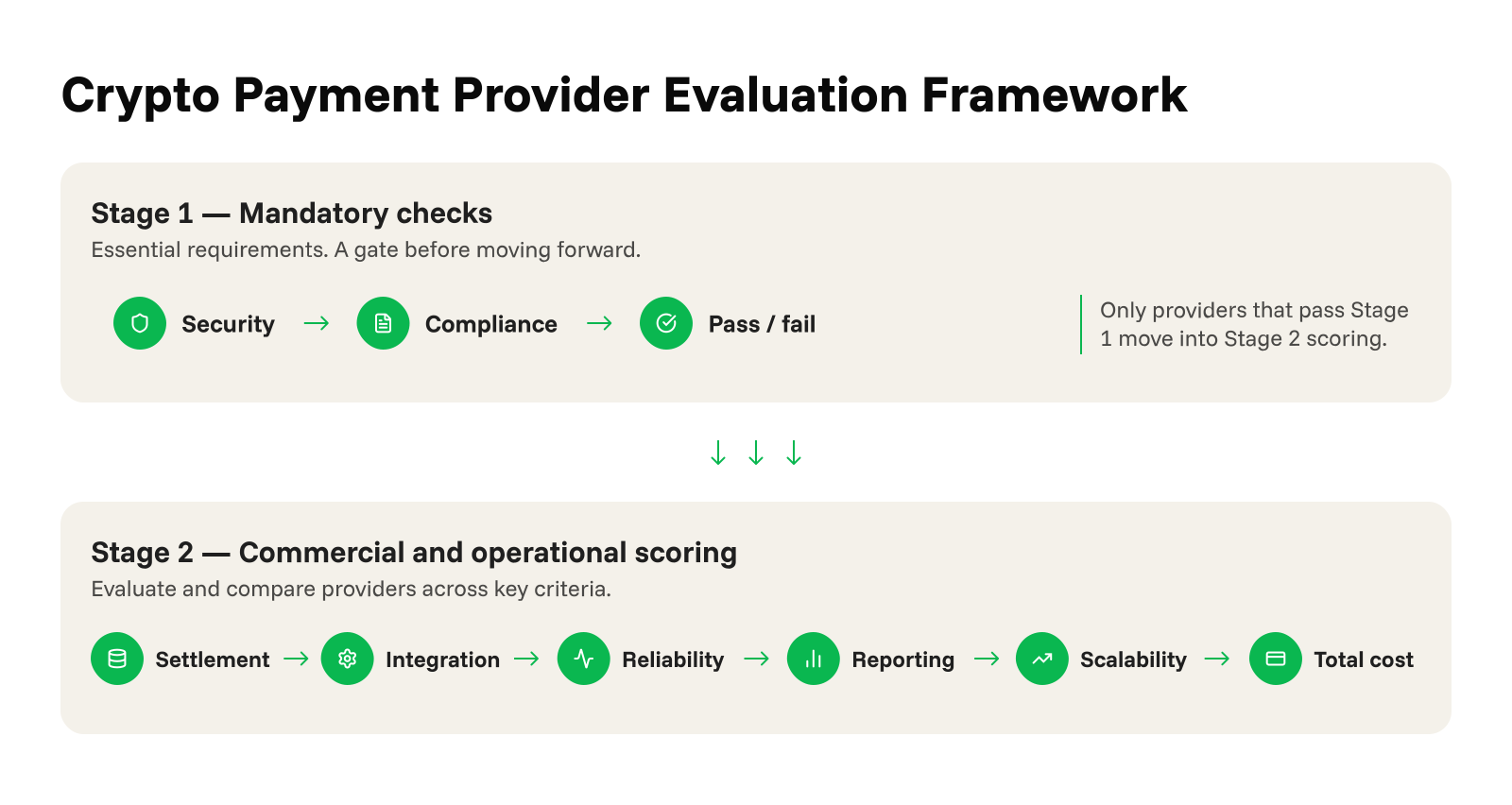
A good selection process treats security and compliance as pass/fail requirements first. Providers that clear those requirements can then be compared on settlement, integration, reliability, scalability and total cost.
A transaction fee is one line in the agreement. The bigger questions are what happens to the payment after it arrives, who controls the funds, how the transaction is screened, how quickly finance can settle it and what happens when something goes wrong

What does a crypto payment provider manage?
A typical merchant payment can pass through several systems before it becomes usable cash or crypto on the company’s balance sheet.
At checkout, the provider generates payment information and identifies the expected asset, blockchain network, amount and destination.
It then monitors the relevant blockchain for the transaction and determines when sufficient network confirmation has occurred. The provider may simultaneously analyse the sending address and transaction history for sanctions exposure or other financial-crime risks.
Once accepted, the payment may remain in the original cryptocurrency, be exchanged into another digital asset, be converted into a stablecoin or ultimately settle to a bank account in fiat.
The final stages concern finance and operations. Payment records need to match individual orders or account deposits, conversion amounts need to be recorded correctly, and transaction data needs to flow into reporting and accounting processes.
This means the provider can potentially influence, among other things:
- Processing and confirmation;
- Wallet and blockchain monitoring;
- Compliance screening;
- Conversion and settlement;
- Reporting and reconciliation;
- Payouts and treasury operations.
This is also why technical, finance and compliance teams should participate in provider selection. Each sees a different part of the risk.
Businesses considering CryptoProcessing’s crypto payment gateway, for example, can accept cryptocurrencies and convert funds into bank payouts, while its payment API supports webhooks, payment-status monitoring and automatic crypto or fiat settlement.
Security: how does the provider protect payments and funds?
Providers need to be able to explain the controls behind their security claims.
Start with wallet management. Ask how funds are divided between hot and cold storage, how assets move between wallets and which approvals are required for withdrawals.
Key controls include multi-signature authorization, address whitelisting, two-factor authentication, withdrawal limits and role-based permissions.
Established providers like CryptoProcessing use cold storage, address whitelisting, 2FA, multi-signature withdrawals and external security audits.
API security also deserves attention. Technical teams should review how credentials are issued and revoked, how webhooks are verified and how permissions are restricted. OWASP’s API Security Top 10 identifies authentication and authorization weaknesses among major API risks.
Independent audits and certifications can provide further evidence. ISO/IEC 27001, for example, sets requirements for managing information-security risks.
Incident response should also be examined. Providers should be able to explain how suspicious activity is detected, whether withdrawals can be frozen, how credentials are revoked and how merchants are supported during an incident.
| Area | What to verify |
|---|---|
| Wallets | Hot and cold storage arrangements |
| Withdrawals | Multi-signature approvals, limits and whitelists |
| Access | 2FA, roles and permissions |
| API | Authentication and webhook security |
| Assurance | Certifications and external audits |
| Incidents | Detection, containment and recovery procedures |
Compliance: can the provider support your regulatory obligations?
Crypto regulation differs by country, activity and legal entity.
Ask which company will sign the contract, what regulatory status it holds and whether that status covers the service being provided.
FATF standards for virtual asset service providers cover areas including customer due diligence, recordkeeping, suspicious-transaction reporting and sanctions controls.
KYB should also be part of the review. Providers may assess company registration details, ownership, beneficial owners, business activity and expected transaction volumes.
Transaction-level controls are key after onboarding. Ask how the provider conducts blockchain analytics, sanctions screening and risk scoring, and what happens when a payment is flagged.
Provider and merchant responsibilities
Provider compliance and merchant compliance cover different obligations.
The provider may handle KYB, AML monitoring, sanctions screening and regulatory reporting related to its service.
The merchant can still retain obligations around its customers, taxes, licensing, consumer protection and the products or services it sells.
Responsibilities should therefore be agreed before launch.
Regulatory status should also be checked for the exact contracting company. This can be divided by jurisdiction – CryptoProcessing’s Legal Hub publishes separate regulatory information for its entities in Europe, the US and Canada.
| Area | What to verify |
|---|---|
| Legal entity | Company providing the service |
| Regulatory status | Regulator, registration and scope |
| KYB/KYC | Business and customer checks where required |
| AML | Monitoring and risk procedures |
| Sanctions | Screening and escalation |
| Geography | Supported jurisdictions |
Settlement flexibility: what happens after the customer pays?
Settlement determines what finance teams ultimately receive.
A customer paying in BTC could result in the merchant receiving BTC, a stablecoin such as USDC or fiat in its bank account.
Crypto settlement
Keeping the original cryptocurrency may suit companies with crypto treasury needs or digital-asset expenses. Finance teams should check supported assets, custody arrangements and withdrawal options.
Stablecoin settlement
Stablecoins can reduce exposure to the price movements associated with assets such as BTC or ETH while keeping funds on-chain.
Businesses can also accept stablecoin payments directly.
Fiat settlement
Merchants can also convert incoming crypto into conventional currencies. CryptoProcessing states that it supports conversion into more than 40 fiat currencies, including USD, EUR and GBP.
Finance teams should compare conversion rates, spreads, settlement timing and banking options.
Automatic and manual conversion
Automatic conversion can reduce exposure between payment and settlement, while manual conversion gives treasury teams more control over timing.
Some providers support mixed approaches, allowing businesses to convert part of their receipts while retaining the rest.
| Method | Best suited to | Check |
|---|---|---|
| Crypto | Crypto treasury | Assets and withdrawals |
| Stablecoin | On-chain treasury | Tokens and networks |
| Fiat | Conventional finance teams | Currencies, FX and timing |
| Automatic conversion | Preset treasury policy | Rates and spreads |
| Manual conversion | Active treasury management | Liquidity and permissions |
Custodial vs non-custodial providers
Custody determines who controls the private keys:
- A custodial provider manages assets on the merchant’s behalf, which can simplify wallet management, conversion and fiat settlement.
- A non-custodial service sends funds to wallets controlled by the merchant, giving the business greater control while placing more responsibility on its internal team.
Neither approach suits every company. The choice depends on treasury requirements, internal expertise and risk policy.
Payment coverage and scalability
Businesses should evaluate future requirements alongside today’s payment volume.
Consider supported cryptocurrencies, stablecoins, blockchain networks, fiat currencies, geographic coverage, transaction limits and multi-entity support.
Network support deserves particular attention. A provider saying it supports USDC, for example, should also specify which chains it supports.
The provider should also be able to explain how its API, compliance processes, support and reporting perform as transaction volumes rise.
Integration and operational reliability
Technical teams should review documentation and test the provider before signing.
A strong integration should handle payment creation, webhooks, confirmations, transaction statuses, refunds, payouts and error handling.
Edge cases matter too. Businesses should know what happens when customers underpay, overpay, use the wrong network or leave a transaction pending.
Reporting is equally significant. Finance teams need to connect payments with invoices, rates, fees and settlement amounts.
Useful records include payment references, original assets, conversion rates, fees, settlement currencies, timestamps and blockchain transaction hashes.
CryptoProcessing’s payment gateway API supports webhooks and payment-status monitoring, while the Back Office provides transaction and balance information.
Reliability should be supported by historical service information and clear incident communications rather than an uptime percentage alone.
Pricing: calculate the total cost
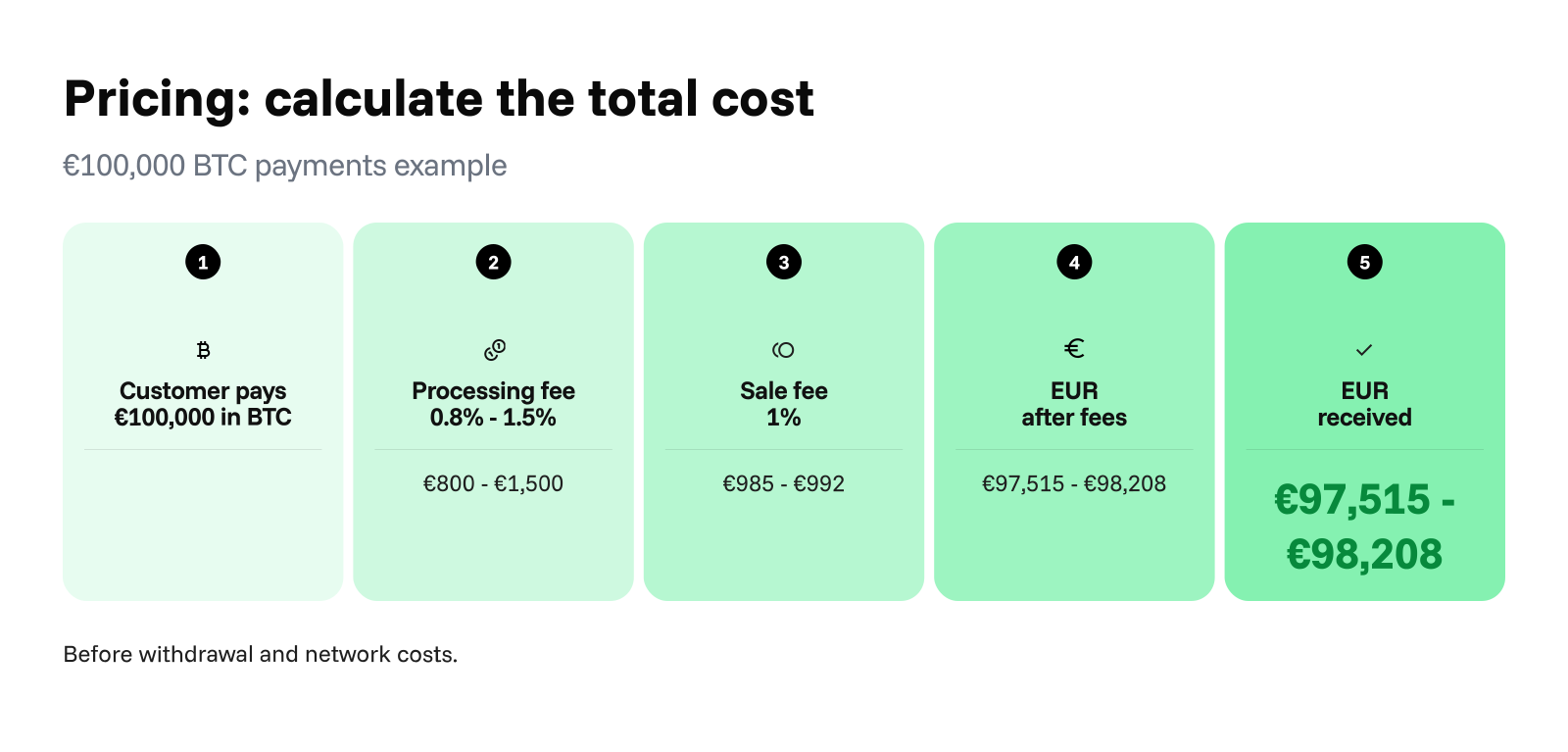
Processing fees provide only part of the cost of accepting crypto. Businesses should calculate what remains after the complete payment and settlement flow.
The main components include blockchain fees, processing fees, crypto-to-fiat conversion charges, FX spreads, withdrawal charges and bank settlement costs.
The impact on blockchain fees, however, on a large payment can be relatively small, with the average Bitcoin network fee in 2026 at around 0.0000059 BTC, or roughly $0.40.
Network fees vary with congestion and transaction size rather than the fiat value being transferred.
Questions to ask before signing
A concise due-diligence review should establish:
Security
- Who controls merchant funds and private keys?
- Which withdrawal controls and certifications are used?
- When was the most recent independent audit?
- What happens during a security incident?
Compliance
- Which legal entity serves us?
- What registration or authorization does it hold?
- How are transactions and sanctions risks monitored?
- Which responsibilities remain with us?
Settlement
- Can we receive crypto, stablecoins and fiat?
- Can conversion happen automatically?
- Which currencies are supported?
- What spreads, thresholds and settlement times apply?
Operations
- How are failed or unusual payments handled?
- Which reports and integrations are available?
- What support is available during incidents?
- Can the service accommodate higher volumes?
Businesses requiring payment and treasury functionality together can also review products such as the CryptoProcessing business account.
Crypto Payment Provider Evaluation Framework
A two-stage process can make provider comparison more consistent.
- Stage one – mandatory checks Security and compliance operate as pass/fail requirements. Verify custody, withdrawal controls, regulatory status, KYB, AML and transaction monitoring before considering commercial factors.
- Stage two – scoring
| Category | Weight |
|---|---|
| Security | 25% |
| Compliance | 25% |
| Settlement flexibility | 20% |
| Integration | 10% |
| Reliability | 10% |
| Cost transparency | 10% |
Score each provider from 1 to 5 in each area and calculate a weighted result.
A high overall score should never compensate for a serious security or compliance weakness.
Red flags when choosing a crypto payment provider
Several warning signs should trigger further investigation before a business integrates. For example:
- Unverifiable regulatory or licensing claims;
- Weak KYB, AML or transaction-monitoring controls;
- Unclear custody and withdrawal security;
- Outdated or poorly documented security audits;
- Hidden conversion spreads or settlement costs;
- Weak API, reporting or reconciliation tools;
- Poor incident response and specialist support.
A useful rule is straightforward: if a provider cannot explain who holds the funds, who regulates the service, how transactions are screened, how money is withdrawn and what the full settlement costs, due diligence is incomplete.
Choosing a provider around the whole payment lifecycle
Transaction fees remain part of provider selection, particularly at high volumes.
But, they belong within a much larger calculation:
- Security determines how safely payments and funds pass through the provider;
- Compliance determines whether the business can operate within the relevant regulatory requirements and manage financial-crime exposure;
- Settlement flexibility determines whether incoming crypto can become the asset, stablecoin or fiat currency that the treasury needs.
Technical reliability then determines whether that process continues working when payment volumes rise, blockchain transactions behave unexpectedly or internal teams need accurate records.
Businesses can improve the decision by starting with mandatory security and compliance checks, then scoring providers according to settlement flexibility, integration, reliability and total cost.
FAQ
How do I choose a crypto payment provider?
Start by verifying the provider’s security controls and the regulatory status of the legal entity that will serve your business. Then compare settlement currencies, conversion options, API capabilities, reporting, reliability and total processing cost. Security and compliance are best treated as mandatory requirements before commercial scoring begins.
What makes a crypto payment provider secure?
A strong provider may combine cold storage, controlled hot-wallet liquidity, multi-signature approvals, address whitelisting, 2FA, role-based access, API security, continuous monitoring, independent security audits and documented incident-response procedures. Relevant standards such as ISO/IEC 27001 can provide additional evidence of formal information-security management.
What compliance features should a crypto payment provider offer?
Capabilities can include KYB, KYC where required, AML controls, blockchain analytics, sanctions screening, transaction risk scoring, suspicious-activity procedures and regulatory recordkeeping. The precise requirements depend on the provider’s activities and jurisdictions.
Should a crypto payment provider be licensed?
Businesses should establish which licenses or registrations apply to the services being provided in each jurisdiction. Verify the legal entity, regulator, authorization or registration number and scope rather than relying on a general statement that a brand is “regulated.” FATF standards call for VASPs to be licensed or registered and supervised according to applicable national frameworks.
What is KYB in crypto payment processing?
Know Your Business is the process through which a provider verifies a corporate customer and assesses its risk. It commonly includes company registration information, directors, beneficial owners, business activities and expected transaction activity.
What is AML transaction monitoring?
AML transaction monitoring analyses activity for indicators associated with money laundering, sanctions exposure and other financial crime. In crypto payments this can include blockchain-address screening, transaction-history analysis, risk scoring and escalation of unusual activity for additional review.
Can businesses receive fiat after customers pay in crypto?
Yes. Some crypto payment providers can accept a customer’s cryptocurrency, convert it and settle the resulting value to the merchant in fiat. CryptoProcessing supports crypto-to-fiat conversion and states that more than 40 fiat settlement currencies are available.
Can businesses settle crypto payments in stablecoins?
Some providers allow merchants to convert incoming payments into stablecoins or accept stablecoin payments directly. Availability depends on the provider, asset and blockchain network.
Is custodial or non-custodial processing better?
The appropriate choice depends on the business. Custodial providers can simplify wallet management, conversion and settlement. Non-custodial arrangements give merchants greater control over private keys while increasing their own responsibility for wallet security and treasury operations.
What cryptocurrencies should a payment provider support?
The answer depends on customer demand and treasury requirements. Businesses should examine both assets and blockchain networks. Support for BTC, ETH and major stablecoins may cover initial requirements, while additional currencies and networks can become relevant as the business expands.
How much do crypto payment providers charge?
Fees vary according to provider, transaction volume, currency and service. Businesses should compare processing charges alongside blockchain fees, conversion costs, exchange-rate spreads, withdrawal costs and fiat settlement fees. CryptoProcessing currently publishes processing fees below 1.5%, with commercial terms dependent on merchant requirements and volume.
What security certifications should businesses look for?
ISO/IEC 27001 is one relevant standard because it sets requirements for an information security management system. Businesses should also review the scope and date of any certification, together with penetration tests, external audits and the provider’s own operational controls.