

Anyone working in marketing or advertising knows that the pace can be quite high and payments often arrive late.
The tension built into traditional finance eats into margins everywhere along the chain: you get late settlements, layered transaction fees, and other hidden costs.
Some quick statistics to illustrate this:
- Agencies, creators, and media buyers routinely wait 60 to 120 days for funds to arrive.
- In 2025, only 51% got paid within 1 week to 1 month.
- 49% of UK creators had late or inconsistent payments affecting their ability to run their businesses, and 41% had turned down work because of cash-flow issues.
- 31% of surveyed creators are looking for payment flexibility options, and 30% want faster access to their earned funds.
- 13.5% of marketers report that processing payments is the single biggest operational problem they deal with.
The vast majority of agencies (71%) say that at least one in every four invoices is paid late. This makes late payments a huge contributor to unpredictable cash flow. More than half of respondents (56%) said it typically takes anywhere from 2 weeks to 2 months after the due date to get paid. Late payments take a significant toll on resources, with 84% of agencies spending at least 3 to 10+ hours per month chasing them.
There’s also another change worth watching: 68% of influencer payouts are now tied to performance metrics rather than flat fees (up from 42% in 2023). This leads to even more tracking, reconciliation, and weeks of unpredictability.
This is where crypto payments come into play.
Crypto is rewriting how marketing professionals collect and distribute money. You get borderless transfers, fees under 1.5%, and no banking middleman pulling funds out of motion. For ad agencies with clients all over the world, creators tired of late payouts, and media buyers navigating high-risk verticals, crypto strips out the parts of traditional finance that slow everything down.
This article walks through how crypto is reshaping marketing and advertising in 2026, why the leading agencies are already on board, and how marketing crypto payments can speed up your cash flow, cut overhead, and open the door to growth.
How crypto is changing the marketing & advertising industry in 2026
Here’s how the transition is visibly happening.
1. Affiliate & influencer marketing: quicker payouts, smaller cuts
Affiliates and influencers have always had the same complaint — getting paid takes too long and costs too much. Cross-border bank transfers can drag on for days or weeks because of banking holidays, FX cuts, and compliance reviews. Crypto allows you to avoid all of that.
- Near-instant borderless transfers. Creators and affiliates can be paid the same day, regardless of which country they sit in.
- No FX issues. Direct crypto-to-crypto transfers skip the exchange-rate shaving that banks layer on every international move.
- Lower fees. Minimizing transactional deductions results in higher net payouts for creators.
This is already being used every day. For instance, Claimr, a Web3 viral marketing platform, processes around €8M in annual volume, and most of it is settled in crypto.
2. High-risk advertising & alternative platforms: payment infrastructure for restricted verticals
Mainstream ad networks aren’t open for every category. Facebook, Google, and LinkedIn tighten their policies, which creates obstacles for crypto projects, iGaming brands, and other so-called “high-risk” verticals.
Crypto ad networks are bridging that gap.
- As mainstream platforms accept less options, crypto-native ad networks are picking up volume.
- Paying for placements in one infrastructure removes friction on both sides, since many high-risk advertisers already operate in crypto.
- Removing the payment bottleneck expands clientele and opens up new revenue.
Demand is rapidly increasing. Industry rankings of the Top 10 Crypto Ad Networks in 2025 show climbing budgets and stronger advertiser pull-through. In 2026, there are more than 153 marketing and advertising companies accepting crypto.
39% of crypto owners are buying with crypto, amounting to ~280M+ people around the world.
3. Martech & SaaS: where the stack catches up to the buyer
Marketing tech vendors such as AI-driven ad platforms, gamified loyalty products, Web3 marketing tooling are adding crypto to their stacks as part of how they position themselves. This is happening for several reasons:
- Crypto fits the category’s digital-first DNA.
- Accepting crypto attracts forward-thinking clients, just the kind looking for vendors who operate ahead of the curve.
- With the evolution of Web3 and blockchain-driven marketing, crypto is on track to become the default infrastructure for many marketing SaaS platforms.
Anyone still treating crypto payments as a niche experiment is missing the bigger picture.
Stablecoins have already overtaken the major card networks by transaction volume. In Q1 2026, the average monthly stablecoin transaction volume was at 6.9 trillion, with Visa at 1.3 trillion and PayPal at 138 billion. While Visa (+1%) and PayPal (+4.92%) showed modest YoY growth, stablecoins exploded by +83%.
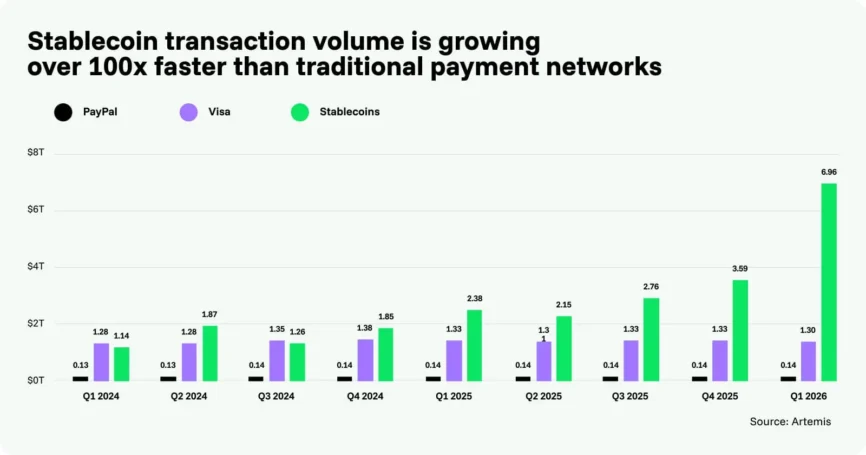
Source: Artemis
Why the marketing & advertising industry accepts crypto
Marketing is built on speed, efficiency, and the ability to pivot. Traditional payment infrastructures answer with delays, fees, and fraud exposure. Because of that, agencies, advertisers, and creators are moving to crypto: it’s faster, cheaper, and harder to defraud.
The easiest way to understand it is to break it down problem by problem.
1. Faster settlement, steadier cash flow
Late payments are no mere nuisance; they’re a serious operational obstacle. For agencies, freelancers, and influencers alike, delayed funds force businesses to run on tight margins, waiting for revenue that’s technically already earned.
The problem:
- Intermediaries park payments for months to earn interest on them, leaving smaller agencies and creators under cash-flow pressure.
- Cross-border bank transfers take days because of FX, compliance, and correspondent banking.
The solution:
- Crypto clears near-instantly and doesn’t involve banks or intermediaries holding the line.
- Agencies, affiliates, and creators receive funds within minutes, which makes cash flow predictable.
2. Lower fees, more margin retained
Every cross-border transaction has some hidden costs. When you’re running ad spend, paying out a roster of creators, or invoicing global clients, those costs can compound fast.
The problem:
- Banks and processors take a bit out of every move, which adds up to thousands in lost revenue every year.
- Hidden fees pile up in the form of FX spreads, correspondent banking charges, and conversion commissions. Compliance and transparency gaps still add 1% to 2% in hidden fees
The solution:
- Crypto transactions tend to run 30–50% cheaper than traditional payment methods.
- Pay directly in BTC, ETH, stablecoins, or other digital assets to avoid FX conversion costs.
3. Stronger security, less fraud exposure
Online payments come with a fraud problem. 22% of merchants won’t accept credit cards at all, specifically because of chargeback and fraud exposure. 70% of businesses say fraud and abuse limit their growth.
The problem:
- Card fraud and chargebacks drain revenue from agencies, advertisers, and creators.
- Dispute resolution and refund handling stretch out the payment process.
The solution:
- Crypto transactions are final and tamper-resistant: there are no chargebacks or fraudulent refund requests.
- Smart contracts (especially in Web3 marketing setups) release funds automatically once campaign terms are met.
4. Open up to new markets and audiences
As discussed above, marketing businesses that accept crypto pick up a clear edge with global, tech-forward, and overlooked audiences.
The problem:
- Younger demographics expect digital-first payment options. In 2026, 70% of marketers will target Millennials, a group already comfortable using crypto online.
- Emerging markets often lack traditional banking infrastructure. A share of consumers in developing economies are skipping the banking layer entirely in favor of crypto.
The solution:
- A direct path to digital-first customers. Millennials, Gen Z, and Web3-native users prefer crypto payments, and businesses that accommodate them separate themselves in crowded markets.
- A natural fit for freelancers and remote teams: crypto payouts move fast, without middlemen, delays, or fees stacked on top.
Crypto payments for marketing: future trends
New payment realities are transforming marketing operations. Here’s a quick look at how it will affect your payouts, ad spend, and your business operations in general.
1. Stablecoins are dominating
For any marketing business that’s considering crypto payments, stablecoins are the safer entry point.
- 80% of crypto shoppers prefer stablecoins over BTC or ETH for day-to-day transactions.
- Stablecoin-linked card spending has grown to $4.5 billion in 2025, up 673% from 2024. B2B payments have increased 733% year over year
This is because of price stability. Bitcoin can move several percentage points in a session, while stablecoins stay pegged to the US dollar (or other fiat). Agencies, media buyers, and creators don’t have to absorb the risk of a sudden drop between invoicing and settlement. That’s why more businesses are adding stablecoin payment options through crypto processing providers like CryptoProcessing in order to maintain a predictable cash flow.
2. Web3 marketing agencies are gaining traction
Traditional ad platforms don’t fit every advertiser. Crypto brands, iGaming operators, and other high-risk categories run into Facebook’s and Google’s strict policies, which is pushing them toward Web3-native marketing agencies for alternatives.
As a result:
- Decentralized ad platforms are gaining ground, letting brands reach audiences without relying on Big Tech’s rules.
- Smart-contract-driven influencer campaigns are increasingly becoming standard practice. Payments release automatically, transparently, and only when creators hit campaign targets.
- NFT-based loyalty programs are also emerging; they give brands new ways to reward customers with assets that hold real engagement value.
This is where marketing is heading: Web3 strategies are opening up revenue lines for agencies that know how to operate in them.
3. AI + crypto = the new ad tech payments infrastructure
Marketing payments will be able to run themselves, at the lowest available cost, with disputes designed out of the system.
- Machine-learning routing layers will optimize transactions automatically, picking the network, fee level, and settlement timing that best fit each transfer.
- Predictive analytics will make budgeting more manageable, anticipating when and how to process payments without overspending.
- Automated smart contracts will reduce processing errors and make sure agencies, freelancers, and creators are paid quickly and accurately.
Once the benefits add up, the next question is finding the provider to handle the integration. We have just the right answer.
Why do businesses trust CryptoProcessing?
CryptoProcessing delivers fast, secure, and cost-efficient infrastructure that fit marketing and advertising businesses. This is why hundreds of merchants rely on it.
1. Lower costs, faster funds in hand
41% of companies have realized 10%+ cost savings through stablecoins, compared to traditional methods. With CryptoProcessing, businesses like Adskeeper saw a more dramatic 30%+ increase in revenue after integrating crypto payments.
2. Broad asset coverage with fast fiat conversion
CryptoProcessing handles Bitcoin, Ethereum, stablecoins, and more than 20 digital currencies, with fast fiat conversion that keeps payment values predictable.
3. Security and compliance built in
Security sits at the center of the platform. CryptoProcessing eliminates chargebacks and operates with full KYC and AML controls, keeping every payment transparent and auditable.
4. Integration that fits the existing stack
Our API-driven architecture plugs into websites, ad platforms, and existing payment stacks. Marketing agencies and media buyers get up and running with minimal setup time and full support along the way.
CryptoProcessing offers a reliable and scalable infrastructure to marketing businesses that want lower costs, faster settlement, and stronger security
| Aspect | CryptoProcessing | TradFi (Banks/PSPs) |
|---|---|---|
| Success Rate | 99% | 84-94% (false and false positive declines 5-20%) |
| Downtime | Network-specific (rare on L2) | Frequent (holidays, de-risking halts) |
| Availability | Yes, global | Limited by hours/banks |
| Failure Cost | Minimal (retryable) | $50-120B/year globally (PYMNTS) |
Summary
Key Takeaways:
- Marketing and advertising businesses lose ground to slow, costly payment systems with too many intermediaries.
- Crypto payments offer near-instant, borderless, low-fee transactions that cut banks and processors out of the flow.
- 68% of influencer payouts are now performance-linked — crypto automates and accelerates the settlement on those.
- Stablecoins dominate crypto transactions in 2026, delivering price stability and faster settlement than legacy methods.
- CryptoProcessing supplies the crypto payment infrastructure for marketing and ad agencies, with fast payouts, multi-currency coverage, and built-in compliance.
How this affects your business
Agencies, creators, and media buyers all revolve around speed. Crypto fixes payout delays, lowers fees, and opens up a global client base. Stablecoins add predictability, which makes cash flow planning a lot less stressful. Today, agencies adopting crypto payments are pulling ahead of competitors and building a durable operational framework for an evolving digital economy.
CryptoProcessing enables marketing and advertising businesses to integrate secure, fast, cost-efficient crypto payments. With support for 20+ cryptocurrencies, near-instant crypto-to-fiat conversion, and built-in compliance, it offers a complete toolkit for modernizing financial operations.