
Crypto ownership in the US has reached such a scale that cryptocurrencies are now commonplace in consumer payments.
Around 67 million American adults now hold cryptocurrency, according to the National Cryptocurrency Association, while 40% of holders say they use crypto to shop for goods and services.
California stands out on the market. NCA-derived state estimates put the number of California crypto holders at approximately 9.5 million, almost twice the estimated total in Texas and more than the populations of many US states.
Reports show a large population familiar with digital assets, growing use of crypto for consumer payments across the US, strong merchant interest in several major industries, and a state licensing regime that covers many digital asset service providers.
Key findings
- 67 million American adults, around one in four, hold crypto, according to the 2026 NCA and Harris Poll research. That represents roughly 12 million additional holders in one year.
- 40% of US crypto holders say they use crypto to shop for goods and services, while 41% send it to friends or family.
- 39% of merchants surveyed across four commerce categories said their businesses accept crypto, while 72% of crypto-accepting merchants reported higher crypto sales over the previous year.
- California has an estimated 9.5 million crypto holders, the highest total of any US state. Based on Census population and age data, this equals roughly 30% of the state’s adult population as an author calculation.
- California’s Digital Financial Assets Law reached its licensing deadline on July 1, 2026. Many companies exchanging, storing or transferring digital assets for California residents now require a licence, a submitted application or an applicable exemption.
Part I – US crypto market
Crypto ownership in the US has entered the mainstream
The NCA’s 2026 State of Crypto Holders research, conducted with The Harris Poll, estimates that 67 million Americans now own cryptocurrency, equivalent to around one in four adults.
The previous year’s estimate stood at roughly 55 million, or one in five adults. That represents an increase of around 12 million holders, or approximately 22% by holder count.
Other surveys produce somewhat different estimates. Security.org’s May 2026 consumer research estimated that 30% of American adults, or approximately 70.4 million people, own crypto. Its study surveyed 992 adults. The NCA research drew on a survey of 10,000 US crypto holders.
For context, a16z puts the estimated global crypto ownership figure at around 725.6 million.
The profile of the US crypto owner
The 2026 data show crypto ownership spreading across a wider range of ages and demographics.
Among people who became holders in 2025 and 2026, 42% are women, compared with 34% among earlier adopters.
The age profile has widened as well. Around 18% of new holders are aged 18 to 24, while 28% are aged 55 or older. More than half of surveyed holders reported combined household income below $150,000.
Geographically, the South accounts for 38% of holders, followed by the West at 27%. The Northeast and Midwest each account for 18%.
For merchants, this creates a potential customer base across a wider range of age groups, incomes, occupations and regions.
Why do people buy crypto?
Crypto is being used for payments
Ownership data show the scale of the crypto market. Usage data show how much of that market already extends into commerce. The National Cryptocurrency Association regularly provides reports on this matter.
In 2026, 40% of surveyed US holders said they use crypto to shop for goods and services, compared with 39% in the previous NCA study.
Another 41% use crypto to send funds to friends and family, up from 31% a year earlier. The share reporting investment as their sole crypto use fell from 20% to 13%.
Applying the 40% shopping rate to the NCA’s estimated 67 million holders produces an audience of roughly 26.8 million Americans who have used crypto for purchases.
Cards, bank transfers and digital wallets remain central to US commerce. Crypto now sits alongside them for a substantial segment of digital asset holders.
US merchants are responding to consumer demand
A 2026 NCA and PayPal study conducted by The Harris Poll found that 39% of surveyed payment decision-makers said their businesses accepted cryptocurrency at checkout.
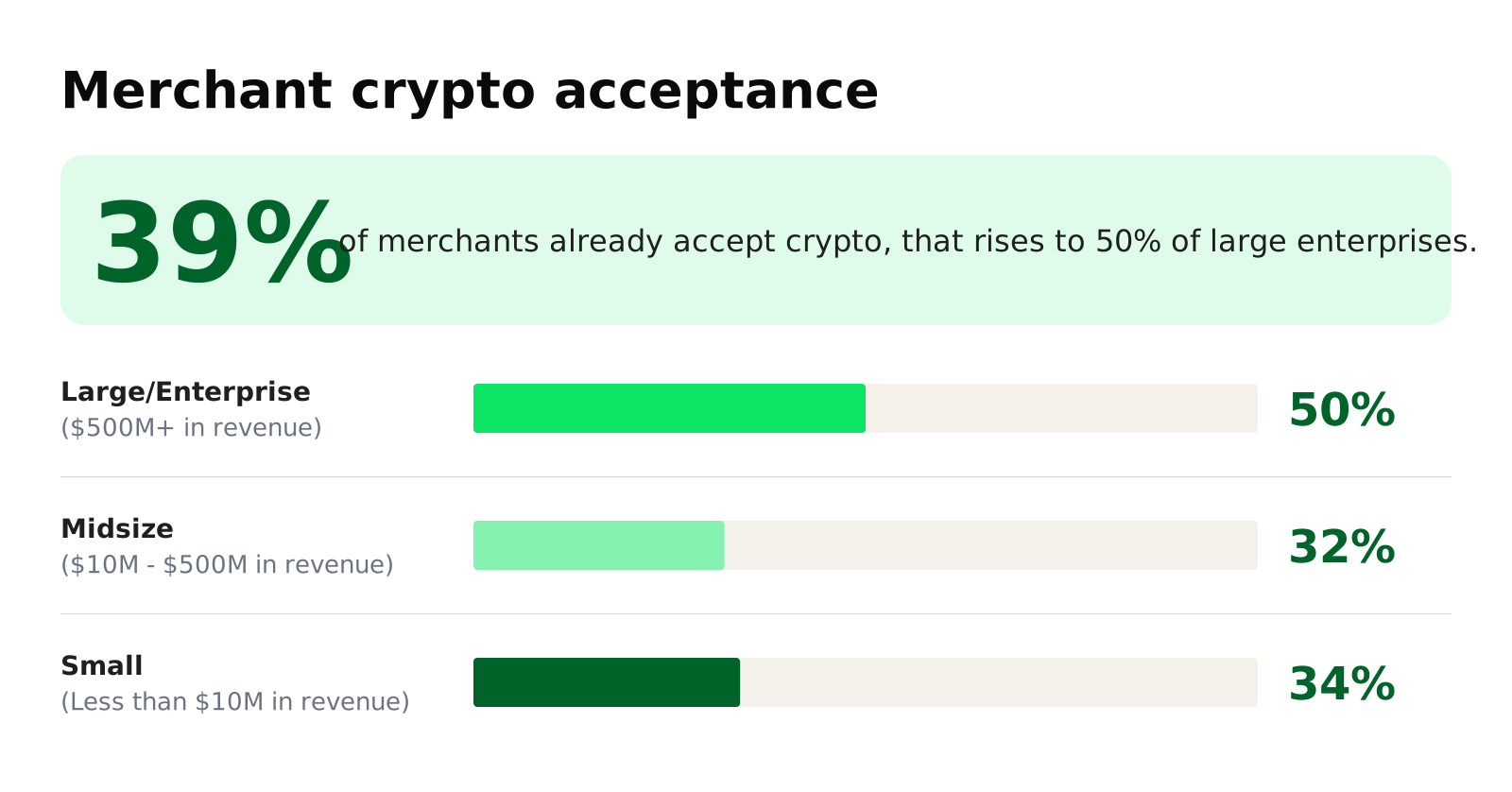
Among businesses already accepting it, 72% said crypto sales had increased during the previous year.
Customer interest appeared throughout the findings:
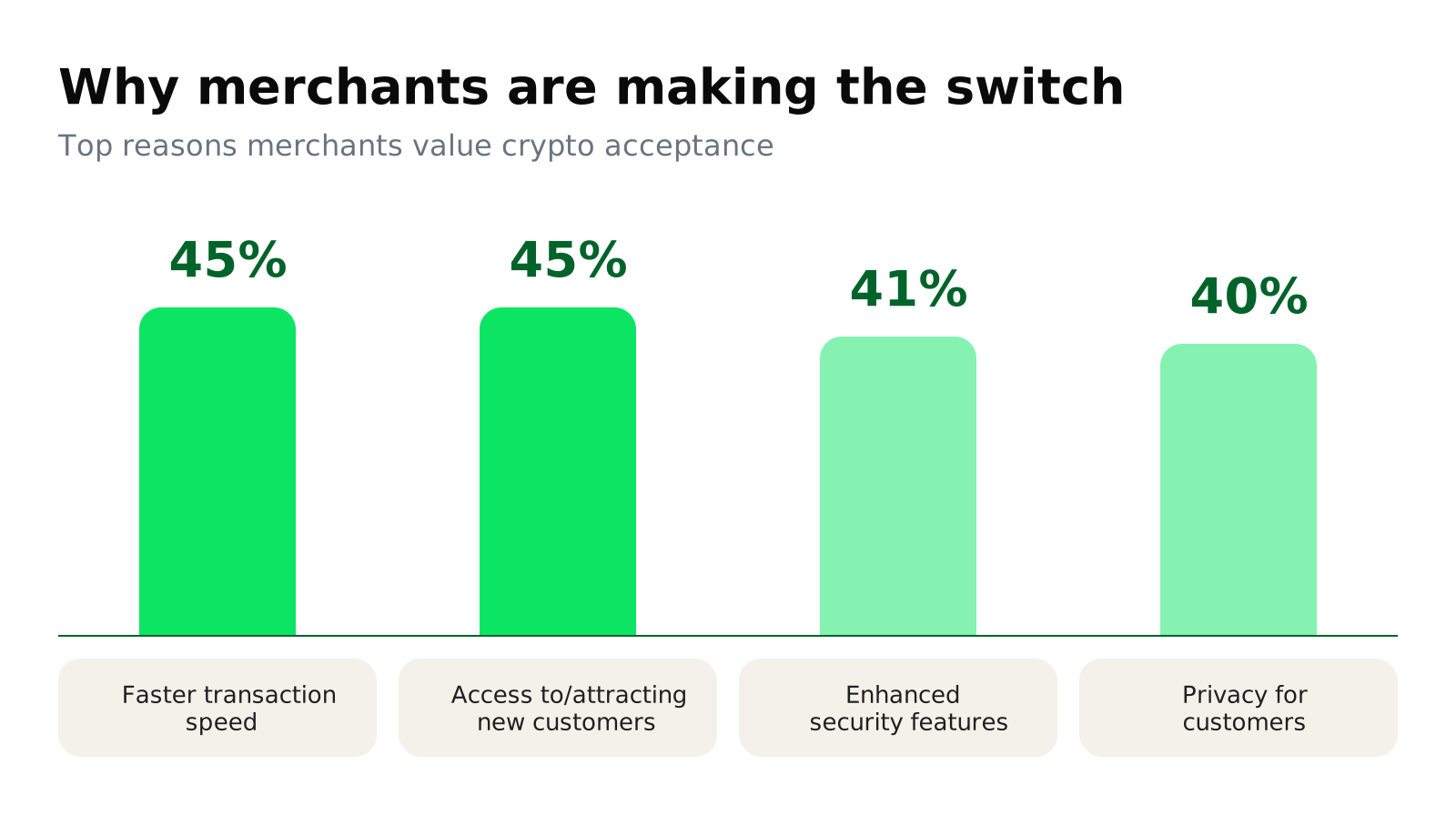
- 88% reported receiving customer inquiries about paying in crypto;
- 69% said customers wanted to use crypto at least once a month;
- 79% agreed that accepting crypto could help attract new customers;
- 84% expected crypto payments to become common within five years;
- 90% said they would be likely to try crypto acceptance if setup were as easy as accepting cards.
The study covered 619 payment decision-makers working in retail and e-commerce, hospitality and travel, luxury and specialty commerce, and digital goods and gaming.
Its reported credible interval was plus or minus 3.9 percentage points at the 95% confidence level.
The 39% figure therefore describes merchant adoption within these selected commerce categories. It provides a useful indicator of adoption in sectors where crypto demand already has commercial relevance.
Which US industries are leading crypto payment adoption?
The highest reported acceptance rates appear in sectors with strong digital commerce or international customer activity.
Industries leading US crypto acceptance
| Business category | Reported crypto acceptance |
|---|---|
| Hospitality and travel | 81% |
| Digital goods, gaming, luxury and specialty | 76% |
| Retail and e-commerce | 69% |
These categories also have a strong commercial presence in California.
Online checkout, international customers, higher-value purchases and digital products can all increase the relevance of crypto payments within these sectors.
Part II – California deep dive
California is the largest US crypto market by number of owners
California leads the country by a considerable margin in the NCA-derived state estimates.
Crypto ownership by state
| State | Average | % of adult population | |
|---|---|---|---|
| 1 | California | 9.5 M | 30 |
| 2 | Texas | 5.94 M | 25 |
| 3 | Florida | 4.71 M | 25 |
| 4 | New York | 4.66 M | 29 |
| 5 | Illinois | 2.64 M | 12 |
| 6 | Georgia | 2.45 M | 28 |
| 7 | Pennsylvania | 2.36 M | 23 |
| 8 | Washington | 2.07 M | 33 |
| 9 | North Carolina | 2.01 M | 23 |
| 10 | Ohio | 1.99 M | 21 |
| Total, all states | 67 M | 25 |
California’s estimated 9.5 million holders are nearly 60% higher than the 5.94 million estimated for second-place Texas.
These figures provide an estimate of geographic market size based on survey and population data.
How much of California’s adult population owns crypto?
The US Census Bureau estimated California’s July 2025 population at 39.36 million, with 20.8% of residents aged under 18. That produces an estimated adult population of approximately 31.17 million.
Dividing the estimated 9.5 million holders by 31.17 million adults gives an implied crypto ownership rate* of approximately 30.5% of California adults.
Using California’s entire population produces a rate of roughly 24%. The adult figure offers the closest comparison with the NCA’s US-wide ownership estimate.
*This percentage is an author calculation based on the NCA-derived holder estimate and Census population data.
Why California is a major crypto payments market
Several sectors associated with high crypto payment activity have a substantial presence across the state.
Travel provides one example.
- California generated $158.9 billion in visitor spending in 2025, supporting around 1.2 million jobs.
- Accommodation spending reached $35.2 billion and food-service spending reached $38.5 billion.
- Hospitality and travel also recorded the highest acceptance rate in the national merchant study at 81%.
Both datasets identify a large California industry where customer demand for crypto payments may be especially relevant.
California also has major retail, e-commerce, entertainment, gaming, digital-service and luxury sectors.
Its international customer base adds another consideration for businesses serving customers across several markets.
Which California business sectors could see the strongest opportunity?
Hospitality and travel
California’s $158.9 billion visitor market serves both domestic and international customers.
At the same time, hospitality and travel recorded the highest crypto-acceptance rate among the categories in the NCA and PayPal study.
Hotels, booking services and tour operators can therefore assess crypto alongside existing payment methods, especially when serving international customers or processing bookings online.
Retail and e-commerce
Retail and e-commerce recorded 69% acceptance within the merchant study.
For California online businesses, crypto becomes more relevant where analytics show a significant crypto-owning customer segment, international traffic or recurring requests for additional payment methods.
Digital goods, gaming and specialist commerce
Digital goods, gaming, luxury and specialty merchants recorded 76% acceptance in the surveyed group.
Digital delivery supports customers across several regions, while gaming and other online-first sectors already have high familiarity with digital wallets and online assets.
Platforms and businesses making high volumes of payouts
The commercial use case also extends to outgoing payments.
Businesses can use crypto or stablecoins for contractor payments, affiliate commissions and marketplace withdrawals.
California-based digital businesses working with recipients in several countries can compare outgoing payment costs and settlement times across bank transfers, stablecoins and other payout methods.
California’s digital asset regulatory environment
The state’s Digital Financial Assets Law, or DFAL, reached its licensing deadline on July 1, 2026.
According to the California Department of Financial Protection and Innovation, companies carrying out covered digital financial asset activity with or on behalf of California residents generally need a DFAL licence, a submitted application or an applicable exemption.
Covered activities include areas such as exchanging, storing and transferring digital assets.
Final DFAL regulations covering licensing requirements took effect on June 29, 2026.
For merchants, regulatory treatment depends on how customer assets are received, exchanged, stored and transferred.
Enterprises should establish several points before adding crypto payments:
- Which entity receives or controls the digital asset;
- Whether a processor exchanges, stores or transfers assets for California residents;
- The provider’s California authorisation status;
- How custody and conversion work;
- Which entity performs customer and transaction compliance checks.
The DFPI advises businesses to review their activities against applicable licensing requirements.
Federal tax treatment also creates accounting requirements.
The IRS requires records showing the US-dollar fair market value of digital assets received as income or business payments, together with relevant transaction and basis information.
Part III – Business implications
What is preventing more businesses from accepting crypto in California?
The NCA and PayPal research points to ease of implementation as a major factor.
Among merchants in the study, 90% said they would be likely to try accepting crypto if setup were as easy as accepting credit cards.
For an enterprise, ease of use extends well beyond adding another checkout button:
- Businesses need to decide which currencies they want to accept and how those funds should be settled;
- Finance teams also need reliable reconciliation and accounting records;
- Compliance teams need visibility into customer and transaction screening;
- Operations teams need procedures for refunds, incorrect payments and network selection.
These considerations often determine how easily crypto can fit into an existing payment operation.
Stablecoins are a key part of the payment case
Stablecoins have become a major part of the commercial crypto market.
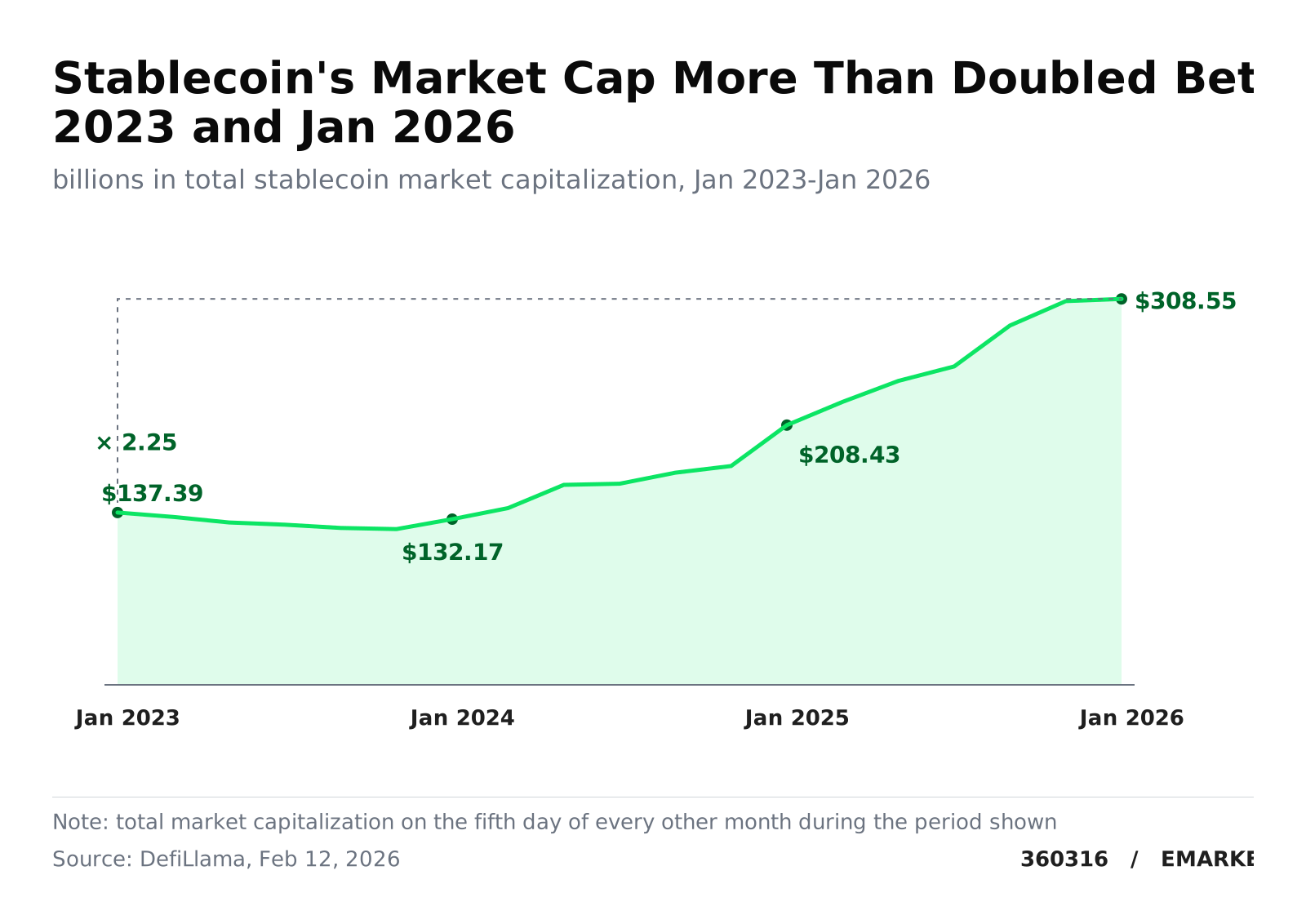
DeFiLlama saw the total stablecoin market cap reach $308.55 billion in January 2026, more than double its level in January 2023.
Their use in payments is also expanding, supported by growing institutional investment and greater regulatory clarity.
For merchants, stablecoins allow customers to make on-chain payments using assets designed to track currencies such as the US dollar.
Businesses can then retain the stablecoins they receive or convert them according to their treasury requirements.
What should California enterprises consider before adding crypto payments?
Customer demand should guide the first stage of assessment.
A business can review where its customers are based, which payment methods they request and how much overlap exists with crypto-owning audiences.
From there, five areas deserve particular attention.
1. Customer use
Review customer geography, demographics, payment requests and existing wallet activity.
The strongest use cases usually appear where customers already use crypto as part of their normal financial activity.
2. Checkout and settlement
Businesses need to decide whether customers can pay in cryptocurrencies, stablecoins or both.
They also need to choose whether received funds remain in digital assets or are converted into traditional currency.
Companies assessing providers can compare Accept Crypto Payments and wider Crypto Processing services with other providers across pricing, settlement options, supported currencies and geographic availability.
3. Regulation and provider status
California businesses should include DFAL status in provider due diligence.
Federal registration, AML controls, custody arrangements and contractual responsibilities also deserve review.
The entity serving the California business and the services it provides should be assessed individually.
4. Accounting, reconciliation and treasury controls
Payment acceptance creates additional finance processes.
Teams need order-level reconciliation, transaction records in dollars, asset conversion records and refund procedures.
Businesses managing digital assets can compare a dedicated Crypto Wallet with other custodial and self-managed wallet options.
5. Outgoing payments
For companies paying large numbers of contractors, affiliates, customers or partners, the use case can extend beyond checkout.
Mass Payouts can be compared with bank transfers and individual crypto transactions across cost, geographic coverage, compliance requirements and reconciliation.
Provider selection should follow the requirements of the individual business, its customers and the jurisdictions involved.
Conclusion – What California’s crypto adoption means for businesses
California enters the second half of 2026 with an estimated 9.5 million crypto holders, giving it the largest crypto-owning population of any US state.
National research also points to substantial payment activity. Around four in ten US crypto holders say they use digital assets to buy goods and services. Merchant research shows particularly high adoption across sectors with a major presence in California, including travel, digital commerce and retail.
The commercial opportunity will ultimately vary by sector and customer base. Digital businesses serving international crypto users may see stronger demand than businesses serving customers who mainly pay by card.
California’s DFAL regime also gives digital asset service providers a defined regulatory framework for operating in the state.
Of course, customer demand and addressable market size can guide the initial decision, but should be followed by considerations such as costs, settlement options and provider authorisation.
Methodology and sources
This report draws primarily on 2026 research from the National Cryptocurrency Association, PayPal, Security.org and the US Census Bureau. California business and regulatory context comes from Visit California and the California DFPI.
US figures cover national ownership, demographics, payment behavior and merchant adoption. California figures focus on estimated ownership, population and state-specific business and regulatory data.
Survey estimates vary by sample and methodology, so this report uses ranges where appropriate. California-specific payment-use data are limited, meaning national trends are used only as reference points for potential state-level demand.
Author calculations include the estimated 30.5% adult crypto ownership rate in California, based on the 9.5 million holder estimate and Census population data, and the 3.8 million potential California crypto shoppers estimate, based on applying the national 40% shopping rate to California’s estimated holder base. These figures are estimates rather than observed state-level survey results.
FAQ
Approximately 9.5 million people, according to state estimates derived from the NCA’s 2026 holder research.
The 9.5 million estimate equals roughly 24% of California’s total population or approximately 30.5% of its estimated adult population. The adult percentage is an author calculation using 2025 Census population and age data.
California, with approximately 9.5 million estimated holders. Texas ranks second with 5.94 million, followed by Florida at 4.71 million and New York at 4.66 million.
The NCA estimates that approximately 67 million American adults owned crypto in 2026. Security.org produced an estimate of 70.4 million in a separate survey, showing how results vary across research methodologies.
The NCA estimates around 25% of American adults, or one in four. Other 2026 surveys have produced estimates around 30%, depending on methodology.
The NCA, PayPal and Harris Poll study found that 39% of 619 surveyed payment decision-makers across four selected commerce categories said their businesses accepted crypto. The figure provides an adoption benchmark for those surveyed sectors.
In the 2026 NCA research, 40% of US crypto holders said they use crypto to shop for goods and services.
Within the 2026 NCA and PayPal merchant study, hospitality and travel led at 81%. Digital goods, gaming, luxury and specialty businesses followed at 76%, with retail and e-commerce at 69%.