

California businesses can accept Bitcoin, Ethereum, USDC, USDT, and other digital assets for taxable sales. The customer’s choice of payment method generally leaves the underlying sales tax treatment unchanged.
The merchant must still determine whether the product is taxable, calculate the correct state and district tax in US dollars, and report the transaction to the California Department of Tax and Fee Administration (CDTFA).
Importantly, a crypto payment introduces an exchange rate, blockchain confirmation, transaction hash, wallet address, processing fee, and settlement record. Each element should connect to the original USD invoice.
In short
California sales tax can apply when a customer pays with cryptocurrency. Calculate the taxable amount and applicable tax in US dollars before converting the invoice into crypto. Record the exchange rate, payment time, transaction hash, fees, settlement value, and wallet details so the sale can be reconciled and reported accurately.
This guide provides general operational information. Businesses should obtain advice from a qualified California tax professional for their particular products, locations, and corporate structure.
The California crypto payment lifecycle
A reliable process keeps the commercial sale, crypto payment, and tax reporting connected from checkout to the general ledger.
California’s statewide sales and use tax rate is 7.25%, while district taxes can increase the total rate based on the applicable location. Retailers remain responsible for reporting and paying the tax due, including when they choose to collect sales tax reimbursement from customers.
A crypto payment gateway can generate the crypto amount, lock an exchange rate, monitor blockchain confirmation, and send payment data to the merchant’s ecommerce platform, API, ERP, or accounting system.
Does accepting crypto change California sales tax?
California generally applies sales tax to retail sales of tangible personal property. A seller’s permit, where your business operates, customer location, and product type determine the tax treatment
Crypto functions as the consideration received for the sale. CDTFA guidance treats barter and exchange transactions as sales or purchases and generally measures the taxable amount using the fair market value of the property or services received.
| Myth | Reality |
|---|---|
| Crypto payments avoid sales tax | The taxability of the product remains the central factor |
| Stablecoins are treated exactly like bank deposits | Stablecoins reduce price volatility but remain digital assets for federal tax purposes |
| A payment processor handles every tax obligation | The merchant remains responsible for product classification, rates, reporting, and records |
| The blockchain record replaces an invoice | The transaction hash supports the record but does not contain every accounting and tax detail |
| Every online sale uses the same rate | District tax and sourcing rules can produce different rates |
Taxability can vary by product. Tangible merchandise is generally taxable, while electronically delivered software, SaaS, and other digital services may receive different treatment depending on the offering and delivery method. CDTFA guidance, for example, distinguishes some electronic transfers from transfers involving tangible media.
Marketplace sellers should also establish whether a registered marketplace facilitator is responsible for collecting and paying the tax. The merchant should retain documentation supporting the facilitator’s responsibility.
How to calculate sales tax on crypto payments
The calculation should begin in US dollars:
- Determine whether the product or service creates a taxable sale.
- Identify the applicable California and district tax rate.
- Calculate sales tax against the USD selling price.
- Add the tax to the customer’s invoice.
- Convert the complete invoice total into the selected cryptocurrency.
- Lock the exchange rate for a defined payment window.
- Record the crypto amount received and the confirmation time.
- Reconcile the payment against the USD invoice.
- Report the taxable sale and tax in US dollars.
Sales tax calculation example
A retailer sells taxable merchandise for $100. The applicable illustrative combined rate is 9.5%.
- Product price: $100
- Sales tax: $9.50
- Total invoice: $109.50
- Illustrative BTC rate: $100,000 per BTC
- Customer payment: 0.001095 BTC
The accounting record should preserve the $100 taxable sale and $9.50 tax liability. Importantly, a later change in Bitcoin’s price does not rewrite the original invoice.
Bitcoin vs stablecoins for California businesses
Stablecoins such as USDC and USDT are designed to maintain a value linked to a reference asset, commonly the US dollar. This can make stablecoin payments easier to reconcile, although it leaves the merchant’s sales tax obligations unchanged.
| Bitcoin | Stablecoins | |
|---|---|---|
| Exchange-rate volatility | Can change materially during checkout and settlement | Usually remains close to its reference currency |
| Accounting | Requires precise valuation timestamps | Easier comparison with USD invoices |
| Treasury | Offers potential price exposure | Supports more predictable cash management |
| Refunds | Requires a defined USD or BTC refund policy | Easier to return the original USD-equivalent amount |
| Reconciliation | Price differences may create additional entries | Fewer valuation differences in normal conditions |
| Customer experience | Payment amount can expire quickly | Longer payment windows may be possible |
| Operational complexity | Higher | Generally lower |
Both assets remain digital assets for federal income-tax purposes. The IRS requires businesses to record the fair market value in US dollars of digital assets received as payment.
Five merchant scenarios
1. Customer pays in Bitcoin
The merchant calculates the invoice in USD, converts the total into BTC, locks the rate, and records the transaction hash after confirmation. If the merchant retains the BTC, a later sale or conversion can create a separate gain or loss for income-tax purposes.
2. Customer pays in USDC
The workflow remains the same, although the USD-linked value makes reconciliation easier. The business should still record the token, blockchain network, wallet address, transaction time, fees, and fair market value.
3. Merchant settles directly into USD
The payment processor receives the crypto and converts it into fiat. The ledger should show the gross invoice, sales tax, conversion, processor fee, and net USD settlement separately. Recording only the net bank deposit can hide revenue and fee information.
4. Merchant keeps crypto on the balance sheet
The initial receipt is recorded at its USD fair market value. The treasury team then tracks the asset’s basis, wallet location, subsequent transfers, and eventual disposal. IRS guidance requires records covering the type of asset, date, time, units, fair market value, and basis.
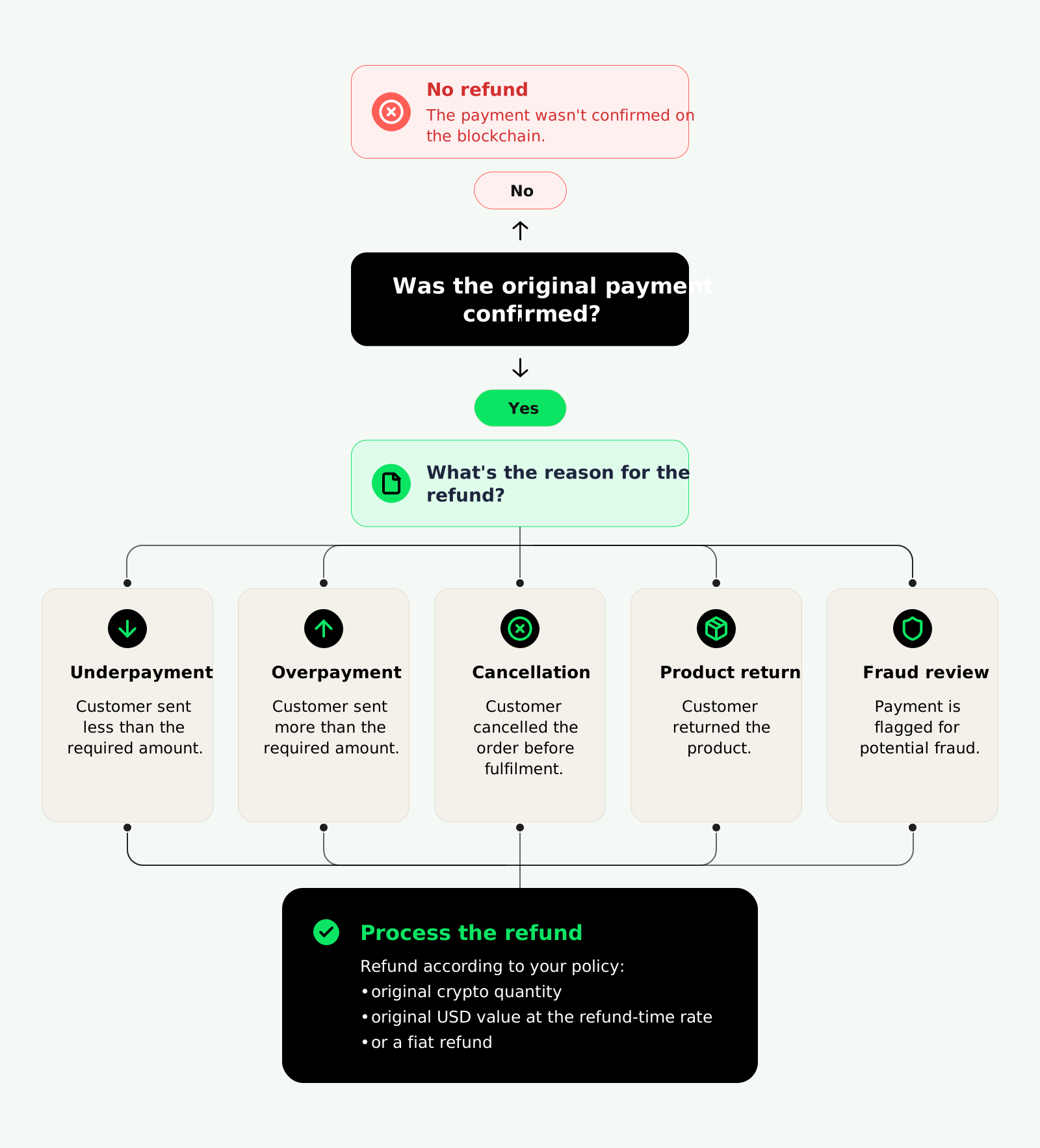
5. Customer requests a refund after Bitcoin moves
The refund policy should state whether the customer receives:
- the original crypto quantity;
- the original USD value converted at the refund-time rate; or
- a fiat refund.
The business should issue a credit record, reference the original invoice and transaction hash, and document the new outbound transaction. Confirmed blockchain payments generally require a merchant-initiated refund rather than a card-style reversal.
Accounting and reporting workflow
The merchant accounting workflow should connect:
Invoice → USD valuation → crypto received → settlement → ledger → reconciliation → tax reporting
At minimum, retain:
- invoice number and customer location;
- product price and sales tax in USD;
- asset and blockchain network;
- quoted exchange rate and source;
- quote creation and expiry time;
- crypto amount requested and received;
- wallet address and transaction hash;
- blockchain confirmation time;
- processing and network fees;
- settlement amount and currency;
- refund or adjustment records.
The IRS treats virtual currency as property and requires sufficient records to support tax-return reporting. It also states that fair market value for an on-chain payment is generally measured when the transaction is recorded on the distributed ledger.
CDTFA sales tax reporting, IRS federal reporting, and California Franchise Tax Board income-tax reporting serve different purposes. Finance teams should avoid combining them into a single undifferentiated crypto entry.
Common crypto accounting mistakes
Frequent errors include:
- recording the settlement value instead of the invoice value;
- applying an exchange rate from the end of the day rather than the documented transaction time;
- omitting district tax;
- treating USDC or USDT as bank cash;
- combining several wallet payments into one unexplained ledger entry;
- omitting the transaction hash;
- recording only net settlement after fees;
- failing to document marketplace facilitator responsibility;
- using inconsistent refund methods;
- mixing customer payments with treasury transfers.
Building an audit-ready crypto payment process
An audit-ready process gives every transaction a consistent reference from checkout through reporting.
A suitable merchant wallet and payment system should support automated invoices, rate locking, unique payment addresses, blockchain monitoring, transaction exports, user permissions, and accounting integrations. Finance teams should also document whether they use a custodial or non-custodial wallet.
A crypto payment gateway can automate several stages:
- calculate the crypto equivalent of a USD invoice;
- assign a wallet address;
- detect underpayments and overpayments;
- wait for the required blockchain confirmations;
- convert crypto into fiat or another digital asset;
- export payment and fee data;
- send signed API callbacks to the merchant’s system.
The USD invoice should remain the anchor for tax and accounting. The crypto record then documents how the customer paid: the exchange rate, payment time, transaction hash, fees, confirmation, and final treasury destination.

California businesses should also review the regulatory status of providers handling exchange, custody, or transmission. California’s Digital Financial Assets Law now covers many businesses engaged in exchanging, storing, or transferring digital assets for California residents. FinCEN guidance also generally classifies convertible virtual currency payment processors that accept and transmit value as money transmitters.
CryptoProcessing can support invoice creation, payment monitoring, exchange-rate management, settlement, and reporting exports. Each merchant should confirm service availability and regulatory suitability for its jurisdiction before integration.
Merchant compliance checklist
✓ Confirm whether the business requires a California seller’s permit.
✓ Classify each product or service for sales tax.
✓ Review where your business has sales tax obligations.
✓ Verify the applicable state and district tax rate.
✓ Generate a USD-denominated invoice.
✓ Calculate tax before crypto conversion.
✓ Document the exchange rate and rate source.
✓ Save the wallet address and transaction hash.
✓ Record gross revenue, sales tax, and fees separately.
✓ Reconcile processor, wallet, bank, and ERP records.
✓ Maintain a written crypto refund policy.
✓ Retain marketplace facilitator documentation.
✓ Separate customer payments from treasury transfers.
✓ Review CDTFA, FTB, IRS, DFPI, and FinCEN requirements with qualified advisers.
Required documentation matrix
| Record | Sales tax | Accounting | Treasury | Refunds |
|---|---|---|---|---|
| USD invoice | ✓ | ✓ | ✓ | |
| Exchange-rate record | ✓ | ✓ | ✓ | ✓ |
| Transaction hash | ✓ | ✓ | ✓ | |
| Processor report | ✓ | ✓ | ✓ | ✓ |
| Wallet history | ✓ | ✓ | ✓ | |
| Settlement statement | ✓ | ✓ | ✓ |
Rounding up: Bitcoin sales tax in California
Crypto changes the payment workflow while the underlying California sales tax principles remain tied to the sale. Businesses that calculate tax in USD, document the conversion, preserve blockchain records, and automate reconciliation can accept digital assets with stronger financial controls and a more complete audit trail.
FAQ: Crypto accounting in california
Does California sales tax apply when customers pay with Bitcoin?
Yes, when the underlying sale is taxable. Payment in Bitcoin does not by itself remove the retailer’s sales tax responsibility.
Does crypto change sales tax obligations?
It changes payment operations and documentation. Product taxability, where your business has sales tax obligations, applicable exemptions, and district tax continue to determine the tax owed.
Should merchants calculate tax before crypto conversion?
Yes. Calculate the product price and sales tax in USD first, then convert the complete invoice into crypto.
Which exchange rate should businesses use?
Use a consistent, documented rate from the payment gateway, exchange, or reliable pricing source at the transaction time. Preserve the rate source and timestamp.
Are stablecoins better for accounting?
Stablecoins can reduce exchange-rate differences and make USD reconciliation easier. They remain digital assets and require wallet, transaction, and valuation records.
What records should businesses keep?
Keep the invoice, customer location, tax rate, exchange rate, asset, network, wallet address, transaction hash, confirmation time, fees, settlement record, and any refund documentation.
Does accepting crypto create capital gains?
Receiving crypto creates a business-income record based on its USD fair market value. Holding and later selling or converting the asset can create a separate gain or loss for income-tax purposes.
How should refunds be handled?
Use a written policy defining whether refunds are based on the original crypto amount, the original USD value, or fiat. Link every refund to the original invoice and payment transaction.
What role does a crypto payment processor play?
A processor can create payment requests, lock exchange rates, monitor blockchain confirmations, support conversion and settlement, and export records. The merchant remains responsible for sales tax configuration and reporting.
Can businesses automate crypto payment reporting?
Yes. Payment gateway APIs, accounting exports, ERP integrations, and automated reconciliation rules can connect invoices, blockchain transactions, settlement records, and tax reports.