
Finance teams need to establish an ability to bring order into the chaos of payment references, transfer identification, conversion and settlement records, as well as various rules related to unresolved differences. Any system built for this purpose needs a way to detect missing data: matching every record it received is insufficient if an entire wallet or reporting period was never imported.
This guide explains how to build that process across multiple wallets, networks and settlement currencies, including the controls needed between the payment platform and your enterprise resource planning system, or ERP.
What crypto transaction reconciliation means at enterprise scale
Crypto payment reconciliation checks that the commercial obligation, blockchain transfer, processor activity and financial records agree. One customer payment can produce several records, including an invoice, an on-chain transfer, a balance credit, a conversion, fees and a later settlement.
A blockchain confirmation answers a narrower question: has a transaction been included in the chain under the network’s rules? It does not identify your invoice or prove that a fiat payout has reached your bank. Ethereum’s proof-of-stake documentation also distinguishes block inclusion from finality. Your integration should preserve the network’s actual status and apply a documented acceptance policy.
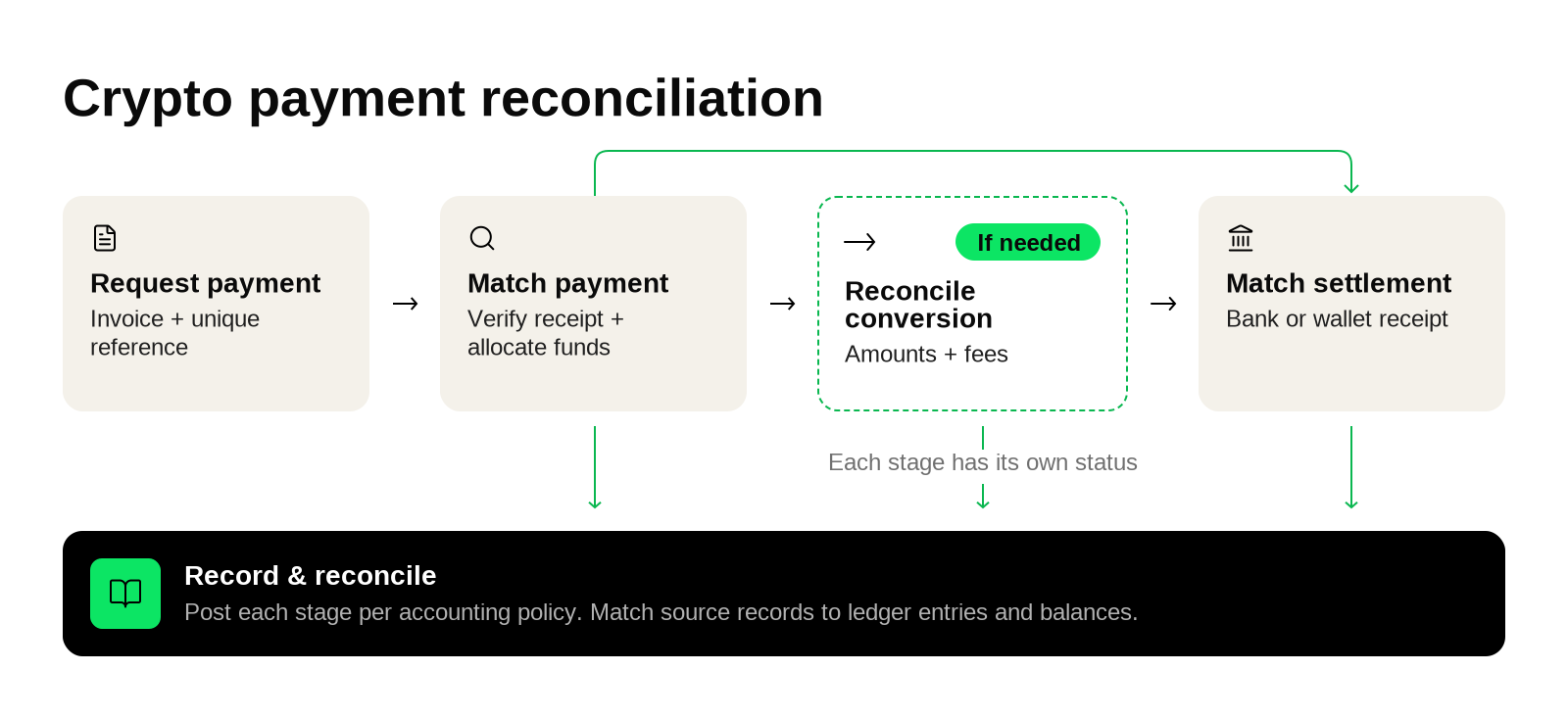
Maintain separate reconciliation states for customer payment, conversion and settlement. A payment can be matched to its invoice while its settlement remains pending. At period-end, the outstanding amount should remain explainable in the relevant clearing or receivable account, according to your accounting policy. A single “complete” flag cannot express all of these conditions reliably.
What causes crypto transaction reconciliation failures?
Most difficult discrepancies start with missing attribution, mismatched units or records that describe different stages of the payment. The controls below address those causes before they become month-end adjustments.
| Problem | Reconciliation impact | Recommended control |
|---|---|---|
| Reused or shared deposit address | Customer attribution is mistaken for invoice attribution | Keep a dated address map and a separate invoice-to-payment link; retain a tag or memo where required |
| Same asset label across networks | An unsupported network or different token is treated as the expected asset | Validate network and contract or native-asset identity against an approved asset register |
| Confirmation or status delay | Finance closes a payment before its acceptance condition is met | Store chain and processor states separately; monitor their age |
| Conversion or currency change | Gross crypto units are compared directly with net fiat proceeds | Reconcile each conversion leg and fee in its own currency |
| Duplicate or missing integration event | One receipt is booked twice or omitted | Use idempotent processing and an independent completeness check |
| Expired request or amount mismatch | Late, partial or excess funds are attached to the wrong obligation | Apply documented allocation and exception rules; retain unresolved amounts |
An internal wallet sweep needs similar care. Moving funds between two wallets owned by the business should not create a second customer receipt. Both sides belong in wallet reconciliation, with ownership and any network fee recorded separately.
How automated crypto transaction reconciliation works
Build the workflow around an evidence chain that finance can follow in either direction, from invoice to bank statement or from a statement entry back to the original payment.
- Create the payment request. Retain the invoice ID, a unique payment-request ID, expected currency and amount, accepted asset and network, and expiry conditions. Store the provider’s returned identifier alongside your own.
- Capture the transfer. Collect the receiving address, required tag or memo, network, asset identity, amount in asset units, transaction identifier and relevant transfer-level identifier. Preserve the original source record.
- Validate receipt and acceptance. Check the destination, asset, execution result and required confirmation or finality state. Map processor statuses explicitly instead of assuming that similar labels mean the same thing.
- Match the payment. Link the transfer to the processor operation and commercial reference. Support partial receipts and multiple transfers against one payment where the payment flow permits them. Reserve each allocated amount so it cannot settle another invoice too.
- Reconcile conversion and fees. Connect each conversion to its input amount, output amount, currencies, execution time and fees. Retain any unconverted balance.
- Match settlement and reconcile finance postings. Connect the settlement instruction or batch to the receiving bank or wallet record. Apply approved ledger mappings at each relevant event and retain ERP posting references, including those created before final settlement.
- Resolve exceptions and check completeness. Route discrepancies to an owner. Compare imported activity and closing balances with independent source totals before closing the period.
Matching payments across wallets and blockchain networks
Build an address register with ownership history
For multi-wallet crypto reconciliation, maintain an inventory of every in-scope wallet, processor account and bank account. Record the owning legal entity, network, wallet purpose and effective dates. Within that inventory, map deposit addresses to customers or payment requests according to the actual allocation model.
A dedicated address may identify one payment, or it may remain assigned to a customer for repeated deposits. A shared address may require a destination tag or memo. Address reuse therefore needs an attribution rule, not a guess based on the most recent open invoice. Preserve historical mappings when an address is retired or reassigned, and avoid reassignment where it would make late receipts ambiguous.
Avoid relying on a sender address as proof of customer identity. Treat it as supporting evidence and use your payment reference and allocation records to establish the commercial relationship.
Identify the transfer as well as the transaction
A transaction hash is useful, but it is not a universal invoice identifier. Ethereum’s JSON-RPC specification exposes transaction receipts containing logs, and individual logs have fields including the emitting address and log index. One transaction can therefore contain multiple transfer events that need separate attribution.
For an EVM token transfer, a practical observation record includes the network, transaction hash, token contract, log index and block hash. The log index is a position within the block. Preserve reorganisation information and revalidate affected observations if a transaction is included again in another block; do not treat a provisional observation as permanently settled. If an affected observation has already been posted, retain its history and use the approved correction process.
Bitcoin uses a different model. Bitcoin Core’s transaction reference exposes a list of outputs and each output’s index. Matching a particular receipt can require the transaction ID plus that output index, together with the network and destination details.
The reconciliation system should translate these structures into a common payment model while keeping the original identifiers. It should not discard network-specific evidence merely to make every import look alike.
Normalize amounts without losing precision
Store crypto amounts in integer base units or an exact decimal representation with an explicit scale. Keep fiat amounts and currencies separate. The ERC-20 standard defines a decimals function for user-facing representation, but makes it optional. Do not assume every token uses the same precision, and verify asset metadata from an approved source.
Use timestamps in a consistent timezone while retaining the source time and its meaning: transaction observation, block time, conversion execution, settlement value date or import time. A date mismatch around midnight should be investigated as a timing difference before being treated as missing money.
Apply exact reference matching first. Amount and time-window matching can suggest candidates, but identical payments make it unsafe as an unconditional rule. Ambiguous candidates should remain open for review.
How should businesses reconcile crypto-to-fiat conversions and settlement?
Crypto-to-fiat reconciliation has to explain how an amount in one asset becomes an amount in another currency. Retain the original payment obligation, crypto units received, converted units, executed rate and time, fees, and settlement evidence. A market quote or reporting valuation cannot replace the conversion record.
| Record | Example amount | What to reconcile |
|---|---|---|
| Invoice | EUR 1,000.00 | Commercial obligation and agreed payment terms |
| Confirmed receipt | 1,100 USDC | Accepted network, token and allocated transfer |
| Gross conversion output | EUR 1,001.00 | 1,100 × EUR 0.91, linked to conversion ID and time |
| Conversion fee | EUR 5.00 | Explicit fee deduction from gross output |
| Settlement fee | EUR 2.00 | Explicit fee deduction before bank receipt |
| Bank receipt | EUR 994.00 | EUR 1,001.00 − EUR 5.00 − EUR 2.00 |
Note: This is a hypothetical example not tied to the CryptoProcessing offering. For this example, we also assume the customer pays the network fee.
The EUR 6 difference between the invoice and bank receipt is explained by EUR 1 more in gross conversion proceeds and EUR 7 in fees. It is not automatically a customer underpayment. Under these assumptions, the invoice is paid; fees and the conversion difference remain separate reconciliation items. Their ledger treatment follows the business’s accounting policy.
For partial conversions, retain the remaining asset units and reconcile each executed leg. If settlement changes from EUR to another currency, add that currency conversion rather than overwriting the first result. If a provider combines several payments into one payout, use a batch allocation that links each payment’s contribution to the batch total.
Stablecoin settlement still needs token units, network, fees and destination evidence. Keeping a stablecoin does not create a bank receipt or make its accounting classification identical to cash. For fiat settlement, match the provider’s instruction with the receiving bank entry and track outstanding items through the relevant value date. Apply rounding at defined stages and post only approved residuals; a broad tolerance can hide recurring discrepancies.
How to automate reconciliation with APIs, webhooks and ERP systems
Collect enough data to prove completeness
A crypto payment reconciliation API is useful only if its records cover the questions your finance team needs to answer. Establish how to retrieve payment references, transaction details, fees, conversion records and settlement evidence. Where a supported history endpoint exists, handle pagination and retain a recoverable import checkpoint. Where it does not, set up an export or statement-based completeness process.
A transaction lookup can confirm a known payment, but it cannot reveal an unknown payment whose notification never arrived. Combine event-driven updates with periodic reconciliation against complete source activity or balance statements. Use an overlap window for repeat imports and deduplicate the results, so a temporary outage does not leave a permanent gap.
For a practical introduction to the integration layer, see CryptoProcessing’s developer integration guide. The implementation still needs to follow the documentation for the merchant’s actual service and API version.
Make webhook processing safe to repeat
Webhooks notify your system about changes; they should not be its only record of payment activity. Validate each callback using the provider’s documented authentication procedure, durably capture accepted events, and process them through a queue. Return the required acknowledgement only after the event has been safely accepted.
Design the consumer to be idempotent: receiving the same event again must not create a second financial effect. Use the provider’s event identifier where available and define a stable deduplication rule where it is not. The financial posting also needs its own unique key, because different notifications can concern the same underlying payment.
Do not assume delivery order matches business-event order. Check allowed status transitions and retrieve current authoritative state when messages conflict. Log failed processing, retain replayable events and alert on gaps. GitHub’s webhook guidance illustrates the general patterns of asynchronous processing and unique delivery identifiers; its headers and timeout rules are not CryptoProcessing specifications.
Keep payment records traceable inside the ERP
Use a reconciliation subledger or integration database to connect operational records before posting approved entries to the ERP. Preserve invoice and entity mappings, asset and currency codes, fee categories, clearing accounts and settlement references. Accounting owners should approve the mapping; an API connection does not decide revenue recognition or asset classification.
If revenue was already recorded with the invoice, a later settlement must not create it again. Retain the external posting key and ERP acknowledgement, and use an approved correction process for reversals or reopened items. The audit trail should show the source record, matching-rule version, posting reference and any manual decision.
CryptoProcessing’s California crypto accounting guide covers the accounting record chain in a US context. The automation architecture here is broader; local accounting and tax treatment require their own policy decisions.
Handling reconciliation exceptions
Automated matching should reduce routine work while keeping unresolved cases visible. Every exception needs a reason, amount, currency, assigned owner, age and next action. “Manual review” is not a complete process unless someone has responsibility and a resolution deadline.
| Exception and likely cause | Detection | Handling and review |
|---|---|---|
| Unmatched deposit from a missing reference or unmapped address | Confirmed receipt has no unique allocation | Investigate ownership and payment evidence; hold in an approved suspense workflow. Human review for ambiguous attribution |
| Duplicate record from a retry or overlapping import | Same source event or posting key appears again | Suppress the extra effect and preserve the delivery log. Review only if payloads conflict |
| Wrong network or token selected by the payer | Asset identity fails the acceptance rule | Isolate the case and contact the responsible operations team. Human review; recovery cannot be assumed |
| Underpayment or overpayment | Allocated amount differs from the request under its terms | Apply the documented payment-flow policy. Require approval for discretionary adjustments or refunds |
| Late payment or delayed confirmation | Expiry passes or confirmation age exceeds its threshold | Recheck authoritative status and payment terms. Escalate persistent delays or uncertain allocation |
| Missing conversion record from an import gap or incomplete execution | Input debit or expected conversion lacks a matching output | Retrieve source records and reconcile the remaining balance. Finance or treasury reviews unresolved differences |
| Settlement discrepancy from fees, batching or timing | Expected net amount differs from receipt | Inspect batch allocation, deductions, currency and value date. Finance approves any adjustment |
| Failed or uncertain payout | Failure status or missing final outcome | Confirm whether funds moved before retrying. Operations reviews uncertain outcomes and applies payout approvals |
A failed blockchain execution also needs separate handling from a missing transaction. Check whether any fee was incurred and retain it even when the intended transfer did not complete. Never mark an invoice paid solely because a transaction hash exists.
At close, reconcile opening balance plus inflows minus outflows, including fees, to the closing balance for each asset and account. Then reconcile those balances with the subledger and general ledger. Investigate mismatches even if the payment-matching report looks clean.
Evaluating crypto reconciliation software and infrastructure
Ask a prospective provider to demonstrate a complete payment using actual sample records: the commercial reference, network-specific receipt, conversion, fees, settlement and exported evidence. A dashboard screenshot does not establish whether the same information is accessible to your integration.
Test difficult cases before expanding volume. Replay a callback and verify that it produces one posting. Interrupt data collection and confirm that the missing period can be recovered. Submit two equal-value payments, a partial payment and a batch settlement, then inspect how the system preserves their separate allocations.
At enterprise scale, also assess API limits, export size, history retention, entity separation, access permissions and the time needed to clear a backlog. Measure automatic matches against a defined population and pair that rate with data completeness, exception age and unexplained value. A high match rate is unhelpful if unresolved payments are excluded from its denominator.
The wider crypto payment provider evaluation guide covers the surrounding security, settlement and operational questions. For reconciliation, insist on evidence that can be exported and independently checked.
How CryptoProcessing supports crypto payment reconciliation
CryptoProcessing’s Crypto Business Account assists with business payment management, while the crypto payment gateway API provides the integration context for businesses. Concrete reporting and callback behavior should be checked in the documentation for the relevant operating entity and account configuration.
Your configuration can include complete automation with crypto-to-fiat conversion or be focused more on stablecoins and reconcile funds according to the practices established in your business. Access to technical support and development tools can also help automate your allocation rules, set up ERP mapping, and generally simplify reconciliation workflows.
Crypto payment reconciliation automation checklist
Setup
Link each request to a unique reference, invoice and legal entity.
Map in-scope wallets and addresses by network, owner and purpose.
Payment matching
Match receipts at transfer level without double allocation.
Automate chain and processor status updates; apply defined acceptance rules.
Conversion & settlement
Record conversion inputs, outputs, rates, execution times and fees separately.
Trace settlements across currencies and batches to receiving accounts.
Posting & recovery
Replay callbacks and imports without duplicate postings.
Assign exception owners, ageing limits and documented resolution steps.
Preserve complete source records for export or recovery after interruptions.
Keep source references and an auditable correction history in ERP postings.
Summary: Creating a repeatable process
Start with a limited payment flow, prove its matching and recovery rules, then extend coverage to more wallets and networks. Keep a comparison against your existing reconciliation process during the rollout and investigate differences before relying on automatic posting.
The useful outcome is a finance team that can identify what was paid, explain every deduction and locate the evidence behind the closing balance. When a payment cannot be closed, the system should make clear what is missing and who will resolve it.
FAQ
How do businesses reconcile cryptocurrency payments
They connect invoices and payment requests with blockchain receipts, processor activity, conversions, fees and settlement records, then compare the results with internal finance records. Separate checks are needed for payment attribution and account-balance completeness.
Can crypto payment reconciliation be automated
Yes. Collection, deterministic matching, status updates and approved postings can be automated. Unclear attribution, missing evidence and discretionary refunds still need controlled exception handling. Automation should preserve those unresolved cases rather than force a match.
How do companies reconcile multiple crypto wallets
They maintain a complete wallet inventory and dated address mappings, import each wallet’s activity, and reconcile both transfers and balances. Internal transfers must be linked across wallets so they are not counted again as customer receipts.
How do you reconcile payments across different blockchain networks
Identify the network and asset explicitly, then preserve the transfer identifiers used by that network. Normalize the records for finance while keeping original transaction evidence and network-specific acceptance rules.
How are crypto to fiat conversions recorded for reconciliation
Record the input asset and units, output currency and amount, executed exchange rate, timestamp and fees under a linked conversion reference. Match subsequent settlement separately. Retain any unconverted units and explain differences under the applicable accounting policy.
What causes unmatched crypto payments
Causes include missing payment references, reused addresses, omitted tags or memos, unsupported networks, late payments, amount differences and gaps in imported data. A payment can also be correctly received but remain unallocated to a particular invoice.
Can crypto payment APIs integrate with ERP systems
Yes, through an integration layer that maps supported payment records into the ERP’s accepted format. Confirm the available fields and retrieval methods. API access alone does not establish a ready-made connector, correct journal mapping or complete reconciliation.
What should enterprises look for in crypto reconciliation software
Look for reliable record coverage, network-aware matching, conversion and settlement evidence, repeatable imports, controlled exceptions and traceable ERP postings. Test data recovery and difficult payment cases alongside ordinary transactions before evaluating performance at volume.