

Fiat payments rely on government-issued money such as USD, EUR, or GBP and usually move through banks, card networks, and payment processors.
Crypto payments, on the other hand, use digital assets on blockchain networks, where transfers are confirmed on-chain rather than by a central institution.
In 2026, the jury is out on which payment method works best for settlement speed, global reach and processing costs.
What is fiat money?
Fiat money is government-issued currency backed by the authority of the state and managed through the banking and central banking system.
Fiat payments usually move through card schemes, bank transfers, e-wallets, and payment service providers. Even where instant payment systems exist, fiat still depends on institutional payment infrastructure and rule-based intermediaries.
The ECB’s TARGET Instant Payment Settlement TIPS system, for example, settles instant payments in central bank money around the clock, which shows how modern fiat systems are improving, even though they remain centrally operated.
What is cryptocurrency?
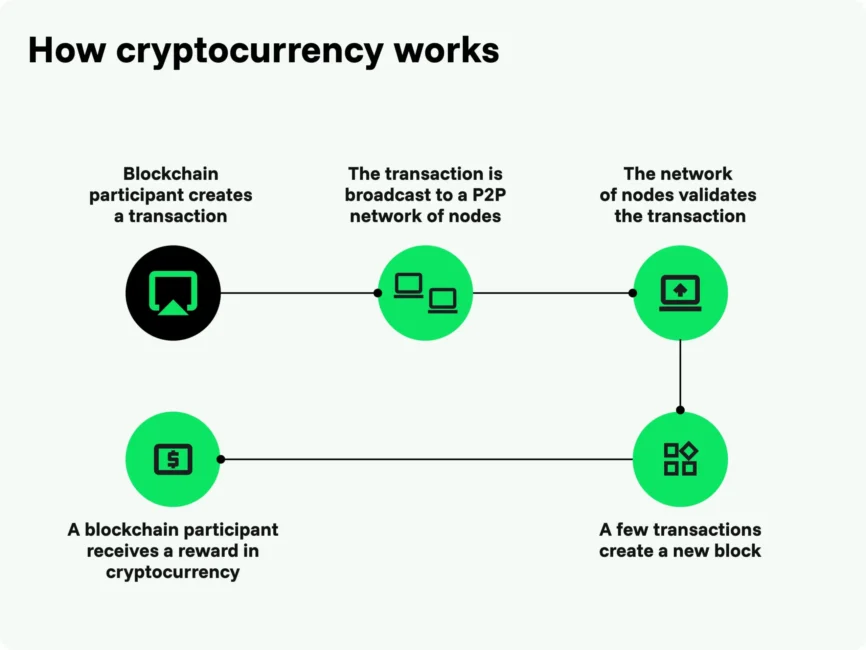
Cryptocurrency is a digital currency recorded on a blockchain rather than in a bank ledger. It can be decentralized, as with Bitcoin, or designed for price stability, as with stablecoins such as USDC. A crypto payment usually moves from one wallet to another, is broadcast to a blockchain network, and is finalized after network confirmation.
Stablecoins have become especially important for business payments because they combine blockchain benefits with a predictable price for settlements.
Crypto vs fiat: key differences
The main difference between crypto and fiat is control. Fiat operates through centralized institutions. Crypto can move through decentralized networks and wallet-based access. That affects speed, fees, transparency, and accessibility.
- Fiat is institution-led → crypto can be peer-to-peer.
- Fiat can be fast, but often depends on banks → crypto settles on-chain.
- Fiat includes intermediary costs → crypto fees depend on the blockchain used.
- Fiat ledgers are private → public blockchains are auditable.
- Fiat usually requires banking access → crypto can be used by anyone with the internet connection
The real question is which payment method makes more sense for a specific use case, region, and customer base. Crypto and fiat payments can and do work in tandem.

Cryptocurrency vs fiat: payment comparison
| Fiat payments | Crypto payments | |
|---|---|---|
| Transaction time | Instant in some systems, but cross-bank transfers still take longer | Settles within minutes, depending on network |
| Processing fees | Often includes processor, card, FX, and intermediary fees | Network fee and processing fee |
| Cross-border capability | Slower and more expensive | Simpler for global payments |
| Chargebacks | Possible with cards and some platforms | On-chain transfers are irreversible |
| Security model | Account-based, institution-controlled | Key-based, wallet-controlled |
Only 35% of global cross-border retail payments were credited within one hour, still well below target. That is one reason businesses compare blockchain payments with bank transfers for international settlement.
Crypto vs fiat money: real-world use cases
Fiat remains the default for salaries, local commerce, and tightly regulated domestic payment flows. It is deeply embedded in taxation, payroll, and mainstream consumer finance.
Crypto is stronger in global payments, online services, digital assets, and environments where speed, direct settlement, or borderless access are valuable.
For businesses, the strongest crypto use cases are usually B2B payments, ecommerce payments, international contractor payouts, and online services serving global customers.
Bitcoin vs fiat currency
Bitcoin is often treated as a long-term store of value or a trading asset, while fiat is still the main medium of exchange for everyday pricing and spending.
Fiat is generally more stable in day-to-day purchasing terms. Bitcoin can offer a different monetary profile, but its price volatility still makes it less predictable for routine payments than stablecoins or bank money.

In payment terms, Bitcoin is often more useful for specific transfers than for everyday pricing.
Blockchain vs fiat infrastructure
- Banking systems are built on regulated institutions, correspondent relationships, clearing arrangements, and central bank settlement.
- Blockchain networks use distributed ledgers and network validation.
Public chains offer stronger auditability and direct asset movement, while fiat systems still offer deeper integration with the existing financial system.
The trade-off is that traditional infrastructure can be more complex and expensive in cross-border settings, while blockchain can reduce some operational steps but introduces wallet management and network selection.
Fiat wallet vs crypto wallet
A comparison between fiat and crypto wallets focuses on custody and control:
- A fiat wallet is usually a bank account, payment app balance, or e-money account managed by a provider.
- A crypto wallet gives access to blockchain-based assets through keys or signing rights.
With fiat, access depends on the institution. With crypto, access depends on wallet custody and key management. A company using a crypto wallet for business needs security controls, role-based access, and operational clarity.
Companies accepting crypto in 2026
Crypto is industry agnostic, and by 2026 it is being used across entertainment, travel, digital services, aviation, and online infrastructure.
- AMC Theatres – entertainment; AMC says customers can buy tickets and concessions with cryptocurrency.
- Namecheap – domains and hosting; Namecheap says it accepts cryptocurrency payments, with crypto added to account funds for purchases.
- Travala – travel; Travala says users can pay for bookings with more than 100 cryptocurrencies.
- airBaltic – aviation; airBaltic lists BitPay among its payment options for flight bookings.
- ExpressVPN – digital services; ExpressVPN says customers can pay with Bitcoin and other cryptocurrencies.
Indeed, crypto payments are no longer limited to exchanges or Web3-native companies and are already being used in real customer payment flows across very different sectors.
How is crypto better than fiat, and where it is not
For certain use cases, crypto has clear advantages over fiat. The strongest arguments in its favor are global reach, programmable transfers, faster settlement, and reduced dependence on payment intermediaries. Crypto can also be more efficient for peer-to-peer payments and cross-border transactions.
But crypto is not automatically better in every context. It still faces volatility in some assets, regulatory variation across markets, and adoption friction for non-crypto users. Stablecoins help, which is why they have become so important in business payment systems.
Which is better for businesses?
For businesses, the answer is rarely all fiat or all crypto. Fiat is usually better for domestic consumer payments, payroll, and compliance-heavy local operations. Crypto is often stronger for global payments, settlement flexibility, and cost optimization in digital commerce.
The most realistic model is hybrid. A business can keep fiat where it works best and add crypto where it improves speed, reach, or conversion. That is why more companies are exploring crypto payment acceptance through gateway tools rather than replacing their whole setup.
CryptoProcessing fits that model by helping businesses use both systems more effectively.
Final thoughts
Digital assets and fiat currencies serve different roles inside the financial system:
- Traditional assets remain dominant in everyday regulated commerce.
- Crypto is gaining ground where direct settlement, global access, and digital-native payments offer an advantage.
Over time, the most useful approach for many businesses will be hybrid, combining familiar fiat systems with blockchain-based payment options where they improve performance.
FAQ – the difference between crypto and fiat
What is the difference between crypto and fiat money?
Fiat is government-issued money managed through centralized institutions. Crypto is digital currency recorded on blockchain networks and accessed through wallets.
Is crypto faster than fiat payments?
Sometimes. Instant fiat systems exist, but many cross-border and bank-based flows remain slower than blockchain settlement. The BIS said only 35% of global cross-border retail payments were credited within one hour in 2025.
Can businesses use both crypto and fiat?
Yes. A hybrid model is often the most practical option for businesses that want local payment familiarity and global payment flexibility.
Which is safer: crypto or fiat?
They use different security models. Fiat depends more on institutional controls and account access. Crypto depends more on wallet security and key management.
Will crypto replace fiat?
There is no sign of a full replacement in the near term. The more likely path is coexistence, with crypto expanding in specific payment and settlement use cases alongside fiat systems.