
International payments can be delayed at several points, from bank cut-off times and compliance checks to correspondent banking, FX processing, and reconciliation. For finance teams, these delays affect supplier relationships, liquidity, cash forecasting, and working capital.
The problem persists despite improvements in payment infrastructure. The Financial Stability Board’s 2025 cross-border payments progress report found only limited global progress toward the G20 targets.
Stablecoin payments can shorten the settlement chain by moving value over blockchain networks that operate 24/7. While compliance, conversion, and off-ramping can still add time, finance teams can use stablecoins to reduce their dependence on banking hours and intermediaries.
Quick answer
Stablecoins reduce settlement delays by replacing several interbank stages with a direct blockchain transfer that can be processed 24/7. A finance team approves the payment, funds the required stablecoin balance, sends the payment through a controlled wallet or payment platform, receives blockchain confirmation, and matches the transaction with the invoice in its ERP.
The greatest benefit appears when the recipient can hold or use the stablecoin directly. If the recipient must immediately convert it into local fiat, the off-ramp becomes part of the settlement timeline and must be assessed separately.
Why settlement delays happen
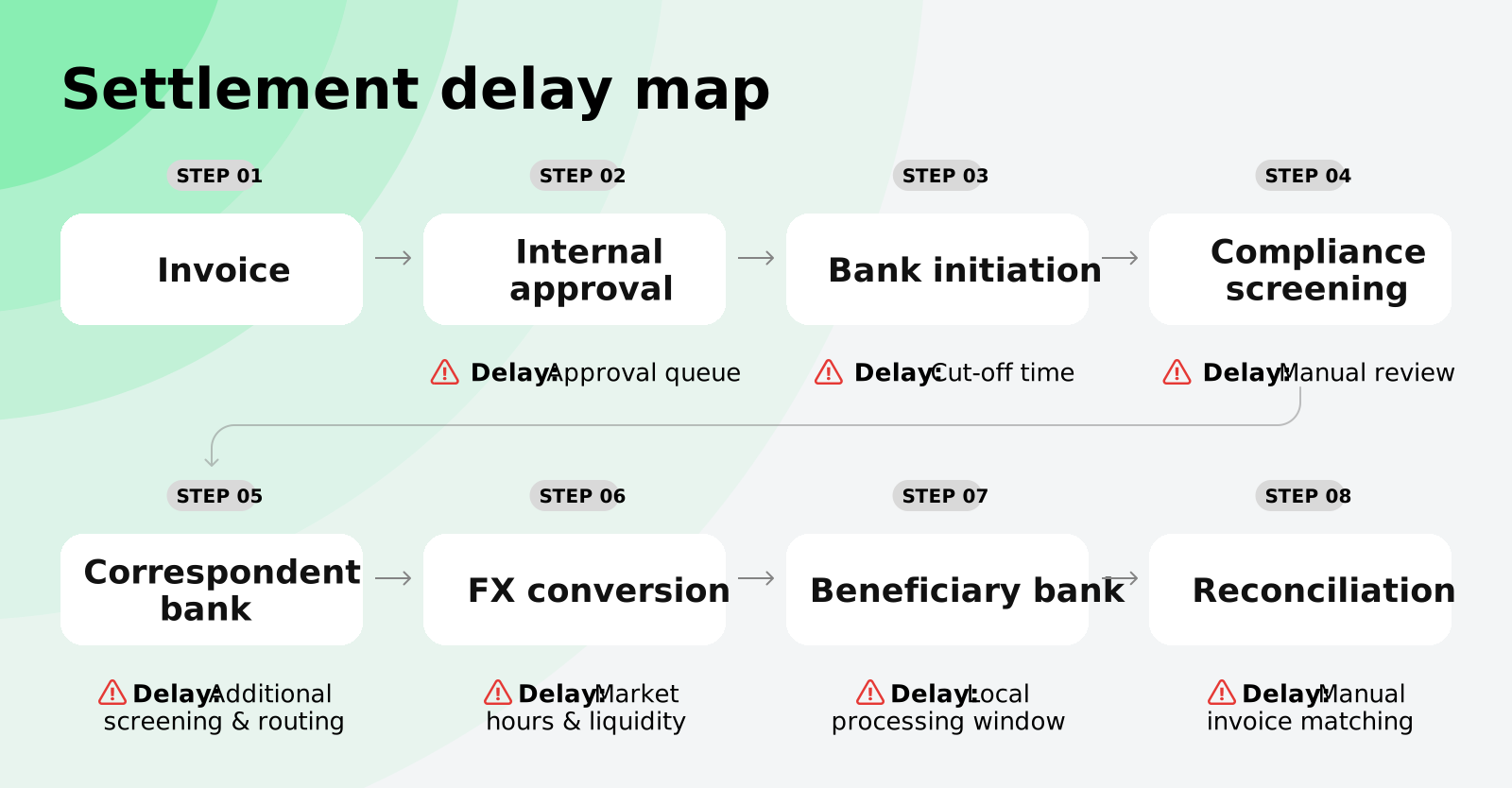
The phrase “international bank transfer” hides several separate operations. The sending and receiving banks may not have a direct relationship, so one or more correspondent banks must move the funds between them. Each institution may process payment messages, conduct screening, check liquidity, calculate fees, and update its own ledger.
The main causes of delay are operational:
- Banking hours and cut-off times. A payment approved after a bank’s daily cut-off may wait until the next business day. Weekends and public holidays can extend that wait.
- Correspondent banking. A transfer may pass through several institutions before reaching the beneficiary’s bank. Each intermediary adds another processing point.
- Compliance reviews. Missing payment details, sanctions screening alerts, unusual transaction patterns, or higher-risk jurisdictions can push a payment into a manual review queue.
- FX processing. Currency conversion may depend on available liquidity, local market hours, internal approvals, and the bank’s conversion schedule.
- Different settlement windows. Payment systems in the sending and receiving countries may operate at different times, with limited overlap.
- Manual reconciliation. Even after the money arrives, finance employees may still need to identify the payment, match it with an invoice, record fees, and close the payable.
Swift’s Payment Optimisation Playbook identifies regulatory requirements, FX conditions, inconsistent data standards, risk controls, and domestic payment infrastructure as major sources of last-mile friction. It also notes that incomplete data and false-positive screening alerts can force payments out of automated processing and into manual review.
Operating hours are particularly important. Restricted operating hours alone can create material delays. A Bank of England model estimated that RTGS closures add around four hours to UK cross-border payments on average. In its model, moving UK RTGS to 24-hour operation reduced this source of delay by around 60% and increased the share of payments that could complete within one hour from roughly 50% to 75%. The model isolates delays caused by RTGS operating hours, rather than estimating total end-to-end payment time. The calculation concerns the UK system rather than stablecoins, but it shows how much delay can come from restricted settlement windows alone.
The settlement lifecycle: traditional payments vs stablecoin payments
A simplified traditional payment follows this sequence:
- Invoice
- Approval
- Bank initiation
- Correspondent banks
- FX conversion
- Settlement
- Reconciliation
A stablecoin payment removes several of those stages:
- Invoice
- Approval
- Stablecoin transfer
- Blockchain confirmation
- Settlement
- Reconciliation
The shorter diagram is useful, but it can also hide important details. Finance teams should measure the complete settlement process rather than looking only at blockchain confirmation time.
The Stablecoin Settlement Lifecycle
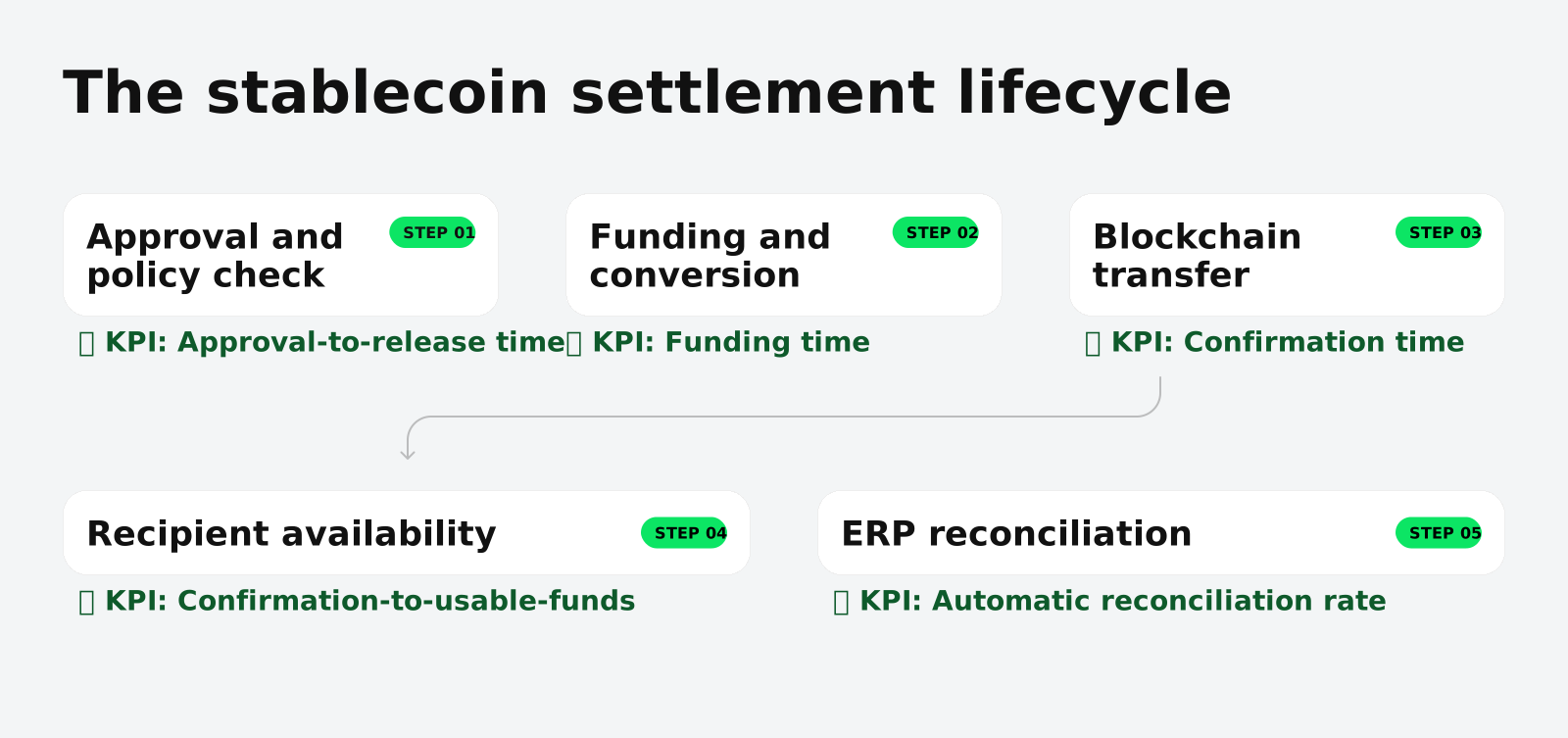
A practical stablecoin settlement lifecycle contains five separate clocks.
- The approval clock. The invoice must still be checked, approved, and released under the company’s payment policy. Stablecoins do not fix slow internal approval processes.
- The funding clock. The business must have enough of the approved stablecoin on the approved network. Funding can come from existing stablecoin liquidity, incoming customer payments, or conversion from fiat.
- The blockchain clock. The payment is submitted to the network and reaches the company’s required confirmation threshold. Depending on the network and provider, this can take seconds or minutes.
- The availability clock. The recipient must be able to use the funds. If the supplier accepts stablecoins, availability can follow blockchain confirmation. If the supplier needs local currency in a bank account, conversion and withdrawal time must be included.
- The reconciliation clock. The payment must be linked to the correct invoice, entity, counterparty, currency, blockchain network, exchange rate, fee, and accounting period.
This distinction prevents a common reporting mistake. A transaction can be confirmed on-chain while remaining operationally incomplete because the recipient cannot use the asset or the accounting team cannot match it automatically.
Why finance teams are adopting stablecoins
Business payments already account for a meaningful share of measured stablecoin activity. Artemis’ Stablecoin Payments from the Ground Up study surveyed 22 stablecoin payment companies and supplemented their data with estimates for 11 others. Researchers attributed $136 billion in stablecoin payments to specific payment use cases between January 2023 and August 2025. By August 2025, payments in the sample were running at an annualized $122 billion, with B2B payments accounting for $76 billion — the largest category in the study. Although it is important to note that these figures should not be read as the size of the entire stablecoin payments market. They represent payments the researchers could attribute to companies and use cases in their dataset.
Stablecoins are also moving into the settlement infrastructure of established payment networks. In December 2025, Visa launched USDC settlement for US issuer and acquirer partners after its stablecoin settlement activity exceeded a $3.5 billion annualized run rate. Cross River Bank and Lead Bank became the first US participants, settling Visa obligations in USDC over Solana. Visa pointed to faster funds movement and seven-day settlement availability, including weekends and holidays, as operational benefits.
For finance teams, the business case is based on several practical improvements:
- Faster settlement. The blockchain leg can complete without waiting for several correspondent institutions.
- Continuous operating hours. Payments can be sent outside normal banking windows.
- Clearer payment visibility. A blockchain transaction provides a shared record of the amount, time, asset, sender, recipient, and transaction status.
- More flexible liquidity. Treasury teams can move stablecoin balances between approved wallets, entities, and counterparties without waiting for the next banking day.
- Better cash forecasting. Shorter and more predictable settlement times make it easier to estimate when a recipient can access funds.
- Treasury flexibility. A business can keep part of its working balance in stablecoins for expected supplier payments while retaining fiat for payroll, taxes, and domestic expenses.
The last point requires discipline. Holding stablecoins is a treasury decision, not an investment strategy. The purpose is to meet known payment obligations, reduce unnecessary conversion, or maintain liquidity for out-of-hours payments.
Stablecoins vs traditional international payments
The right comparison is not “old money versus new money.” It is evaluated based on whether a specific rail produces the required outcome for a particular corridor, counterparty, amount, and deadline. For a broader overview, see this comparison of crypto and fiat payments.
| Factor | Traditional international payment | Stablecoin payment |
|---|---|---|
| Settlement speed | Same day to several business days, depending on the banks, corridor, screening, and FX | Blockchain confirmation can take seconds or minutes; total time depends on funding, compliance, and any off-ramp |
| Operating hours | Often affected by bank hours, cut-offs, weekends, and holidays | Blockchain transfer is available 24/7 |
| Payment visibility | Status may be distributed across several banks and payment messages | On-chain status is visible, but useful business visibility still requires API and ERP integration |
| Cost | May include bank, correspondent, lifting, FX, and beneficiary fees | May include provider, network, conversion, custody, and off-ramp fees |
| FX exposure | FX may occur inside the banking chain, sometimes with limited rate visibility | A dollar stablecoin reduces transfer-value volatility but still creates USD exposure for a company operating in another currency |
| Traceability | Records may be spread across bank statements and payment messages | The transaction has an auditable on-chain record plus any metadata stored by the payment platform |
| Liquidity | Banks may require prefunding or use correspondent balances | The sender needs available stablecoin liquidity; the recipient needs sufficient market or off-ramp liquidity |
| Treasury efficiency | Familiar controls, but often batch-based and business-day dependent | Supports API-led transfers, weekend settlement, and automated treasury rules |
| Reconciliation | Often based on bank references and statement files | Can use transaction hashes, payment IDs, webhooks, and structured settlement reports |
| Primary risk shift | Bank, correspondent, FX, and processing risk | Issuer, custody, wallet, network, compliance, and off-ramp risk |
A stablecoin payment is not automatically cheaper or faster in every case. A domestic instant payment may already settle in seconds. Stablecoins tend to offer the clearest advantage where the payment crosses borders, operating hours do not overlap, the banking chain is long, or the recipient already uses digital dollars.
Operational use cases
The strongest use cases share three characteristics: the payment is time-sensitive, the banking route is inefficient, and the recipient can accept or readily convert the stablecoin.
Supplier payment
A workflow might look the following:
- The supplier issues an invoice in an agreed currency.
- The buyer approves it in the ERP, creates a payment through its stablecoin payment infrastructure, and sends USDC, USDT, or another approved asset to a verified address.
The blockchain leg may complete within minutes. End-to-end settlement can also be completed quickly when the supplier retains the stablecoin. Conversion into local currency may extend the process.
In that case, the buyer gets a clearer payment timestamp, while the supplier receives usable value sooner and can release goods without waiting for a bank transfer. From the perspective of operations, cross-border supplier payments can be processed outside banking hours. The payment also produces a transaction identifier that both parties can verify.
Urgent inventory purchase
A manufacturer may need to pay for a component on Friday evening to secure a shipment or production slot. A traditional wire could miss the bank’s cut-off and remain pending until Monday.
With a stablecoin workflow, an authorized finance employee can release the payment through a preapproved platform, subject to the company’s normal limits and dual-approval rules. The supplier can verify receipt without waiting for the buyer’s bank to reopen.
In that case, the main benefit is not merely speed but the ability to act during a period when the alternative payment rail is unavailable.
Intercompany settlement
A global group may need to settle balances between subsidiaries, reimburse shared expenses, or move funds to an entity responsible for supplier payments.
Stablecoin settlements can simplify the transfer leg when both entities operate approved wallets or accounts. Treasury can also net obligations first and transfer only the remaining balance.
The finance benefit is more predictable intercompany liquidity. However, each entity still needs proper documentation, transfer-pricing treatment, accounting entries, and local legal review. A blockchain transfer does not remove those obligations.
Treasury rebalancing
Companies with several payment providers, operating entities, or regional accounts often maintain liquidity in multiple places. Moving money between them can become difficult during weekends or outside local bank hours.
A stablecoin treasury balance can act as an additional liquidity bucket. Treasury can move funds between approved locations, cover an unexpected payout requirement, or prepare for a supplier run in another time zone.
This does not eliminate the need for cash buffers. It can, however, reduce the amount of liquidity that must remain idle in every individual account.
Global payroll funding
Stablecoins can be used to fund a payroll, contractor, or mass-payout provider that supports digital-asset settlement. The company transfers the required amount to the provider, which then pays recipients through the agreed method.
The stablecoin leg may settle quickly, but employee receipt still depends on local payroll rules, the provider’s controls, and the selected payout method. For that reason, many companies use stablecoins to fund the payout infrastructure rather than sending salaries directly from an unmanaged corporate wallet.
How stablecoins fit into a treasury workflow
A controlled treasury workflow can look like this:
- Invoice
- Approval
- Stablecoin transfer
- Settlement
- Treasury update
- Accounting
- Reporting
The transfer is only one part of the process. Treasury also needs to track the source of funds, conversion rates, fees, and when the recipient can actually use the money.
There are different philosophies here, and one thing people often miss is that accounting and treasury are not the same. For example, if you’re an electronics merchant in Europe, you’re selling in euros. You accept crypto, convert it into euros, and your accounting is clean. But if you need to pay a supplier in Asia in USDC next week, does it make sense to convert everything into euros today and then buy USDC again in a few days?

This is where stablecoin treasury can reduce unnecessary conversions: finance teams can keep part of the incoming USDC available for a known USDC obligation instead of converting the same value twice.
It is worth mentioning that this approach only makes sense when it is supported by a defined treasury policy. The policy should specify:
- Which stablecoins and blockchain networks are approved
- Maximum balances and holding periods
- Which entities may hold or send stablecoins
- Who can create, approve, and release a payment
- When funds should be converted into fiat
- Which exchange-rate source accounting should use
- How transactions are recorded and reconciled
- What happens if a network, issuer, or payment provider becomes unavailable
Reconciliation deserves particular attention. A transaction hash is useful evidence, but it is not a complete accounting record. The finance system should also capture the invoice number, legal entity, counterparty, asset, network, gross amount, fee, conversion rate, timestamp, approval history, and final settlement status.
Risks finance teams should manage
Stablecoins change the risk profile of a payment. They may reduce some risks associated with long settlement chains but introduce new dependencies that must be governed.
Issuer and redemption risk
A stablecoin is a liability of its issuer or arrangement, not central bank money. Treasury should review reserve composition, disclosure frequency, legal redemption rights, eligible redemption parties, and performance during stressed markets.
The FSB’s recommendations for global stablecoin arrangements emphasize clear redemption rights, effective stabilization mechanisms, liquidity management, operational resilience, and settlement finality.
Counterparty and provider risk
The business may depend on a custodian, processor, exchange, banking partner, or off-ramp. Due diligence should cover licensing, safeguarding arrangements, financial condition, service continuity, incident response, and withdrawal procedures.
Wallet governance
Direct wallet use requires strict control of private keys, address whitelists, user permissions, recovery procedures, and transaction approvals. A wrong-address or wrong-network payment may be difficult or impossible to recover.
Finance teams should approve the stablecoin and the network as one combination. “USDC” alone is not a complete payment instruction if the asset is available on several blockchains.
Transaction monitoring and compliance
Stablecoin transfers remain subject to sanctions, AML, counterparty, and Travel Rule requirements where applicable. The FATF has called for stronger controls around stablecoins and unhosted-wallet transactions, including risk assessment, information sharing, blockchain analytics, and supervision of relevant intermediaries.
FX exposure
USDC and USDT are designed to track the US dollar. That reduces volatility relative to assets such as Bitcoin, but it does not remove currency risk for a company whose functional currency or liability is euros, pounds, yen, or another currency.
Treasury should define whether the stablecoin balance is a short-term payment asset, a dollar exposure, or both.
Accounting and tax
The accounting treatment of stablecoins varies by jurisdiction and company policy. Finance teams should determine recognition, valuation, fee treatment, realized gains or losses, documentation, and tax reporting before the first material transaction.
Operational resilience
A complete contingency plan should cover network congestion, provider outages, delayed withdrawals, temporary loss of a peg, unavailable off-ramps, compromised credentials, and errors in recipient information. The business should retain an alternative fiat route for critical obligations.
Building a modern settlement strategy
The practical goal is not to replace every bank payment with stablecoins but to give treasury a second rail and a routing policy.
A business can continue using domestic instant payments for local obligations, bank wires for counterparties that require them, cards for consumer purchases, and stablecoins for corridors where they improve speed, availability, or payment visibility.
A modern payment orchestration policy can route transactions according to:
- Country and regulatory eligibility
- Payment amount
- Currency and FX requirement
- Urgency
- Banking cut-off time
- Recipient preference
- Stablecoin and network liquidity
- Total provider and conversion cost
- Required payment finality
- Availability of a reliable off-ramp
For most finance teams, the infrastructure decision is whether to operate corporate wallets directly or use crypto processing that handles more of the payment lifecycle, including transaction processing, conversion, settlement, and reporting.
CryptoProcessing provides a managed layer for payment creation, blockchain status tracking, compliance controls, conversion, payouts, and reporting. Its API can also connect payment statuses and transaction data with internal systems. The exact services, assets, fiat paths, and settlement options depend on the business setup and jurisdiction.
For companies planning a technical rollout, crypto payment integration can connect payment requests, live transaction statuses, conversion rules, controlled payouts, and reporting with existing finance systems.
Finance team checklist
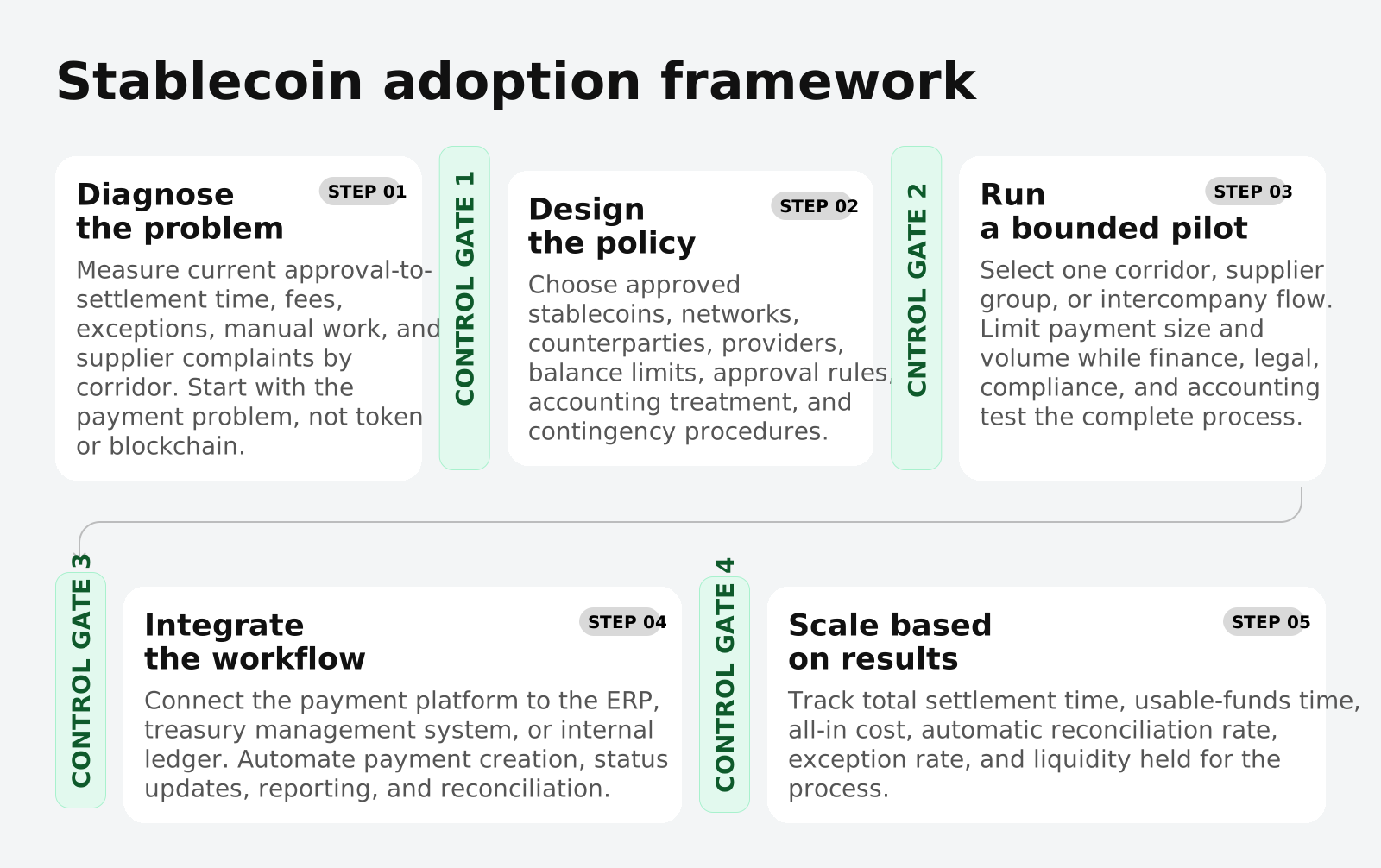
Before introducing stablecoin settlements, finance and treasury teams should confirm the following:
- Select the settlement currencies and business corridors.
- Define an approved stablecoin and blockchain-network list.
- Review issuer reserves, redemption rights, liquidity, and regulatory status.
- Establish maximum balances, holding periods, and treasury limits.
- Configure maker-checker approvals and recipient-address whitelists.
- Document the accounting, valuation, fee, and tax policy.
- Connect payment IDs and transaction data to the ERP.
- Automate reconciliation and create an exception queue.
- Implement sanctions screening and transaction monitoring.
- Monitor approval, confirmation, usable-funds, and reconciliation times.
- Test fiat fallbacks and business-continuity procedures.
- Generate regular treasury, compliance, and management reports.
Stablecoins solve payment problems, not investment problems
For a CFO or controller, the case for stablecoins is based on whether a payment reaches the right counterparty, in the right currency, with the right controls, at the required time.
Stablecoin settlements can reduce dependence on banking hours, shorten cross-border payment chains, improve payment visibility, and give treasury teams more control over out-of-hours liquidity. They can also reduce the amount of time funds remain difficult to locate or use.
The strongest model is usually hybrid. Fiat remains essential for taxes, salaries, domestic commerce, and counterparties that require bank settlement. Stablecoins provide an additional rail for international payments, supplier payments, intercompany transfers, treasury rebalancing, and other time-sensitive operations.
Modern payment infrastructure brings blockchain settlement into existing finance operations, linking each transaction to approval workflows, transaction monitoring, liquidity controls, ERP reconciliation, and financial reporting. This gives finance teams a consistent process for managing stablecoin payments alongside existing payment rails.
FAQ
Why are international settlements delayed?
International settlements may pass through several banks, compliance systems, FX processes, and domestic payment infrastructures. Different operating hours, incomplete payment data, manual screening, correspondent banking, and beneficiary-bank processing can all add time.
How do stablecoins reduce settlement time?
Stablecoins move over blockchain networks that operate continuously. A direct transfer can replace several correspondent-banking stages and does not need to wait for a conventional settlement window. The complete timeline still includes approval, funding, compliance, recipient access, and reconciliation.
Are stablecoins suitable for treasury operations?
They can be suitable for defined short-term payment and liquidity needs. Treasury should set approved assets, networks, providers, limits, holding periods, and conversion rules. Stablecoins should not be treated as risk-free cash or introduced without an accounting and compliance policy.
Which stablecoins are most commonly used?
USDT and USDC are the most widely used dollar stablecoins in many tracked payment flows. Artemis found that both were central to its payment dataset, with USDT accounting for the larger share of the measured transactions. Popularity alone does not determine suitability; the business must also assess the issuer, network, redemption route, liquidity, and local rules.
Can businesses combine fiat and stablecoin payments?
Yes. A company can use stablecoins for selected cross-border or out-of-hours payments and retain fiat for domestic obligations, taxes, payroll, or suppliers that require bank transfers. Payment orchestration can select the rail according to cost, speed, currency, risk, and counterparty preference.
How do finance teams reconcile stablecoin transactions?
The payment platform should pass a payment ID, transaction hash, asset, blockchain network, amount, fee, timestamp, exchange rate, counterparty, and final status into the ERP or reconciliation system. Exceptions such as partial payments, wrong amounts, or delayed conversion should be placed in a review queue.
What risks should treasury teams consider?
The main risks include stablecoin issuer and redemption risk, custody and counterparty risk, wrong-address or wrong-network transfers, compliance exposure, dollar FX exposure, accounting uncertainty, provider outages, and insufficient off-ramp liquidity.
How quickly can suppliers receive stablecoin payments?
The blockchain transfer may be confirmed within seconds or minutes, depending on the network and required confirmation threshold. A supplier that accepts the stablecoin can often use it soon after confirmation. A supplier that needs local fiat must also complete conversion and withdrawal, which may take longer.
Can stablecoins improve cash flow?
They can improve the timing and visibility of cash flow by reducing settlement delays and making funds available outside banking hours. They do not create additional working capital, and any stablecoin balance held in advance still represents deployed liquidity. The benefit should be measured through lower cash-in-transit time, smaller buffers, or faster access to inventory and services.
How does payment infrastructure support treasury operations?
Stablecoin payment infrastructure can manage payment creation, approvals, wallet addressing, blockchain confirmation, conversion, transaction monitoring, reporting, and reconciliation. APIs and status callbacks connect those processes to the company’s ERP, treasury system, or internal ledger, turning a blockchain transfer into a controlled finance operation.