

Expert contributor: Igor Skirnevskii, Chief Product Officer at CryptoProcessing
Payment infrastructure now shapes how quickly a company can release goods, pay suppliers, forecast cash, and enter new markets. It also determines how much operational work sits between an approved invoice and a reconciled ledger entry, shaping the efficiency of day-to-day payment operations.
The scale of the underlying market explains why the decision belongs on the finance agenda. McKinsey estimated that the payments industry generated $2.5 trillion in revenue from $2.0 quadrillion in value flows and 3.6 trillion transactions worldwide.
At the company level, the consequences appear in working capital, foreign exchange leakage, failed payments, reconciliation workload, liquidity buffers, fraud exposure, and audit readiness. Finance teams should evaluate the complete operating model. That includes bank and payment service provider coverage, settlement mechanics, treasury controls, reporting, API integration, security, compliance, and the provider’s ability to scale with the business.
Why payment infrastructure matters for finance teams
Global payment infrastructure acts as a financial control system. It determines when a payment becomes final, which balance funds it, how foreign exchange is priced, what data returns to the ERP, who can approve an exception, and how the provider handles a rejected transaction.
The latest Financial Stability Board (FSB) global KPI report available by July 2026 showed wide variation in cross-border performance. For a modeled $20,000 B2B payment, the average sending cost was 1.6%, with foreign exchange accounting for 87.1% of it. Only 2.2% of services credited the recipient within 1 hour, while 39.6% did so within 1 business day.
These figures show why finance teams should assess both the all-in cost and the time until funds become usable: a quoted transaction fee captures only part of the economics, while a provider’s definition of settlement may not match the company’s definition of cash availability.
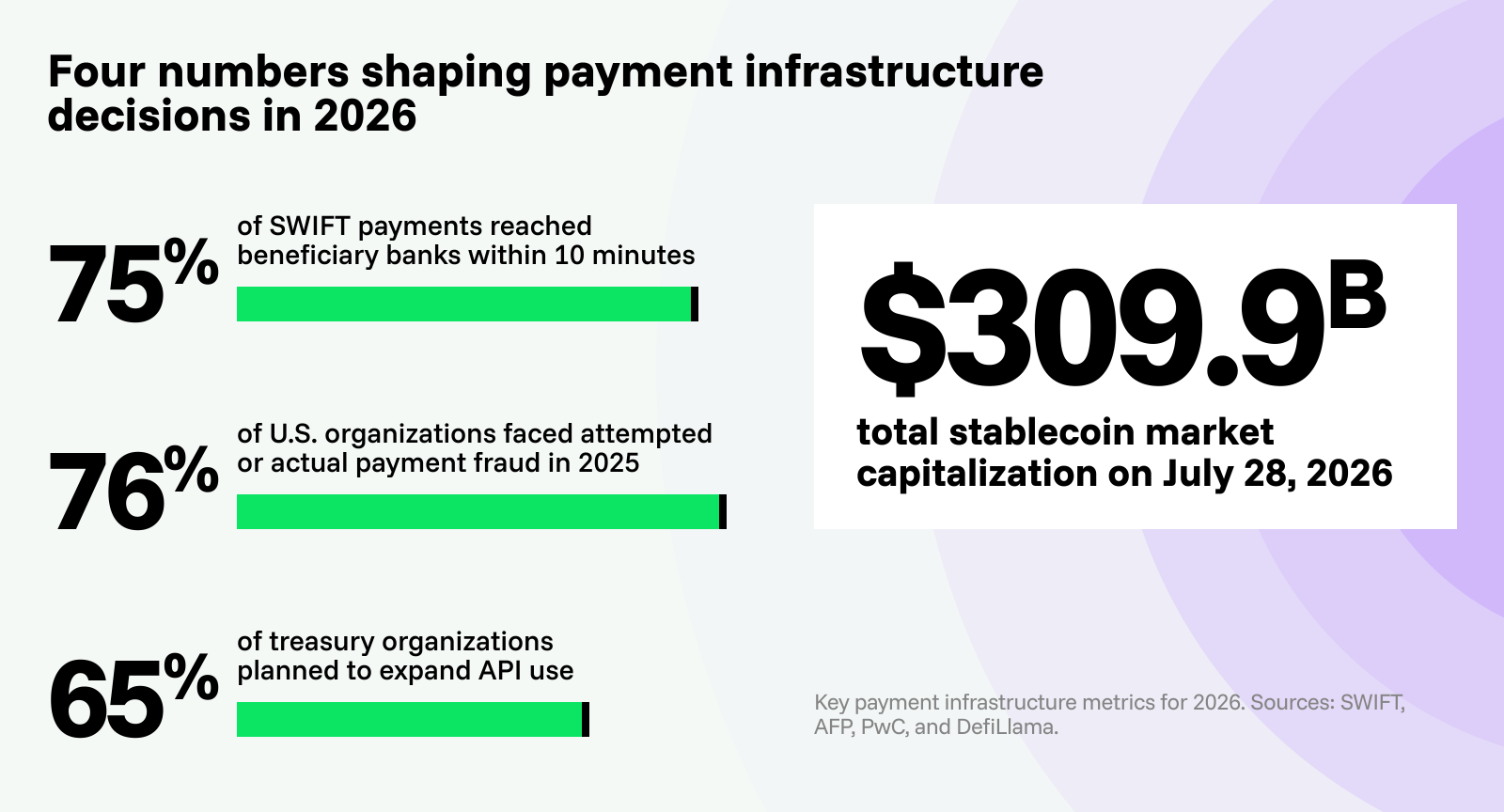
SWIFT reported that 75% of payments reached the beneficiary bank within 10 minutes, although the in-flight stage represented less than 20% of the complete cross-border journey. Finance teams therefore need end-to-end timing that ends when the beneficiary can use the funds.
Payment infrastructure also affects broader financial operations and supplier relationships. Predictable international settlements help procurement teams negotiate payment terms, reduce uncertainty around shipment release, and avoid emergency wires. Clean transaction data gives accounting teams faster close cycles and gives treasury teams a more reliable view of available cash.
Understanding your current payment infrastructure
A payment evaluation should start with a factual map of current flows. Vendor presentations become more useful after finance understands where the existing process loses time, money, data, or control.
Map existing payment flows
Start by documenting each material flow by legal entity, corridor, currency, beneficiary type, purpose, value, frequency, and urgency. Record the bank account, payment provider, gateway, or digital asset rail used. Cover supplier payments, refunds, payouts, intercompany transfers, payroll-related payments, and treasury movements.
For each flow, finance teams should then assess the following:
- Capture the timestamps for initiation, approval, funding, provider acceptance, beneficiary credit, and reconciliation.
- Separate explicit fees from foreign exchange spreads, intermediary deductions, receiving fees, and internal labor costs.
- Record the data returned by each provider, including status codes, transaction references, and settlement files.
- Identify the teams involved in each payment and the systems where manual entry occurs.
Identify bottlenecks and operational risks
Common friction points include bank cut-off times, weekend gaps, manual approvals, beneficiary data errors, sanctions reviews, compliance holds, insufficient balances, unpredictable foreign exchange rates, and weak status visibility. Finance teams should also flag processes that depend on one employee, one bank portal, or one spreadsheet.
Measure payment performance
A baseline turns vendor selection into a measurable process. Useful metrics include the straight-through processing rate, failed and returned payment rate, median and 95th percentile time to beneficiary credit, all-in cost by corridor, manual touches per payment, reconciliation cycle time, unresolved exceptions, and liquidity held for pre-funding.
Recognize when the existing setup no longer scales
Warning signs include rising exception volumes, new markets that require bespoke workarounds, inconsistent data across providers, slow month-end close, manual cash positioning, and recurring requests for emergency payments. A payment infrastructure for businesses should absorb growth without forcing finance to add headcount at the same rate as transaction volume.
Core evaluation criteria
Finance teams should score providers against the same operating criteria and the same representative corridors. A single global average can hide weak performance in the markets that matter most.
“Traditional businesses tend to focus more on predictability, regulatory clarity, and ease of integration. For many of them, crypto payments are an extension of existing payment operations rather than a fully native ecosystem. We also see different attitudes toward settlement and treasury management: traditional businesses typically prioritize fast fiat conversion and reduced volatility exposure.”

Settlement speed
Measuring the complete journey from initiation to usable beneficiary funds, while tracking funding, conversion, provider acceptance, final settlement, and returns as separate operational events, is essential. Ask the vendor for median and 95th percentile performance by corridor, currency, value band, and payment type. Also, you might need to confirm how weekends, holidays, cut-off times, compliance reviews, and beneficiary bank practices affect the result.
Domestic payments may settle through a single local clearing system, while international payments can involve FX conversion, intermediary banks, compliance checks, and multiple cut-off times. Finance teams should measure domestic and international settlement times separately and set corridor-specific SLAs.
Real-time processing can improve cash flow and supplier experience, but pre-funding requirements may offset part of the working capital benefit. Batch processing can remain efficient for predictable, high-volume flows when the batch window matches business needs.
Payment costs
A low headline fee doesn’t establish a low total payment processing cost. Build an all-in model that includes provider charges, bank and intermediary fees, foreign exchange spread, beneficiary deductions, pre-funding cost, refund or return charges, wallet or network fees where relevant, and the labor required to investigate exceptions.
As part of the evaluation process, you may run the model on real corridors and values that include comparing the amount debited from the payer with the amount available to the beneficiary. The FSB data showed that foreign exchange accounted for 87.1% of the average cost of the modeled B2B payment, which made FX methodology a central vendor question.
Geographic coverage
Separate marketing coverage from operational coverage. A provider may advertise a country while supporting only selected currencies, beneficiary types, bank routes, transaction sizes, or legal entities.
It is worth checking countries, currencies, local payment methods, payout limits, required documents, operating hours, local account requirements, restricted sectors, and return handling. Finance teams should also assess provider concentration by region. A second route for critical corridors can reduce outage and counterparty risk.
Treasury and liquidity management
International payment infrastructure should give treasury a consolidated view of balances, funding needs, conversions, and settlement obligations. Based on that, it is recommended to evaluate multi-currency accounts, automatic conversion rules, rate locks, netting, sweeping, liquidity thresholds, cash forecasting data, and support for centralized payment models.
PwC’s 2025 Global Treasury Survey found that 36% of respondents still used a manual FX exposure management process. It also found that 65% planned to expand API use in the next few years. The findings linked payment modernization to better cash visibility, liquidity management, and working capital control.
Finance teams should quantify trapped cash and pre-funding. It includes asking whether balances are segregated, interest-bearing where permitted, withdrawable on demand, and visible in real time. After, it might be possible to confirm how the provider manages liquidity during market stress and outside local banking hours.
Reconciliation and reporting
Reconciliation quality often determines whether a payment solution succeeds after launch. Every payment should carry a stable transaction ID and return the payer, beneficiary, timestamps, gross amount, net amount, fees, FX rate, status, failure reason, refund data, and settlement reference required by accounting.
Finance teams might need to test automated reconciliation against the ERP, accounting platform, or treasury management system. Meanwhile, reviewing file formats, APIs, webhooks, export schedules, status taxonomies, duplicate controls, and correction workflows may be useful for informative evaluation. Audit-ready reporting should let finance trace a ledger entry to the original instruction and final settlement without rebuilding the history across portals.
The 2025 Cash Forecasting and Visibility Survey found that 35% of respondents used 6 or more U.S. banks, while 34% used 6 or more international banks. That level of fragmentation increased the importance of consistent data and centralized visibility.
Security and compliance
Payment infrastructure concentrates sensitive data and authority to move funds. Vendor due diligence should cover licensing, safeguarding, AML, KYC or KYB, sanctions screening, transaction monitoring, fraud controls, data residency, retention, incident response, business continuity, and independent assurance.
The 2026 AFP Payments Fraud and Control Survey found that 76% of U.S. organizations experienced attempted or actual payments fraud in 2025. Financial losses were reported by 48% of organizations with revenue below $1 billion and 66% of organizations with revenue above $1 billion.
As part of a security and compliance evaluation of a potential provider, you might need to review multi-factor authentication, dual approval, least-privilege access, role segregation, API key rotation, address whitelisting where applicable, transaction limits, anomaly detection, callback procedures, and recovery controls. Ask for recent penetration-testing results, certification scope, uptime history, recovery objectives, and a clear incident escalation path.
Compliance requirements also keep changing. FATF approved revisions to Recommendation 16 on payment transparency in June 2025 and opened a consultation on implementation guidance in June 2026. Vendors should explain how their data model, screening, and payment messages will support evolving originator and beneficiary information requirements.
Integration capabilities
An API should support the full payment lifecycle. So it is recommended to evaluate authentication, idempotency, webhooks, batch submission, bulk payouts, error handling, retry logic, rate limits, versioning, sandbox quality, and documentation. As a result, you should be able to confirm that the provider can connect to ERP, accounting, treasury, procurement, and customer platforms without manual data bridges.
Payment orchestration adds a control layer across banks, PSPs, and digital asset rails. It can route payments by corridor, currency, cost, availability, risk, or service level. The model improves resilience when finance has clear routing rules, consistent data, and ownership of exceptions.
Integration testing should include duplicate requests, timeouts, partial failures, reversed transactions, provider outages, late webhooks, and schema changes. Ask how the vendor communicates breaking changes and how long older API versions remain supported.
Questions every finance team should ask vendors
A structured vendor session keeps the discussion focused on evidence. Finance teams should ask:
- How quickly did payments settle in our priority corridors during the last 90 days?
- What percentage arrived within the stated SLA, and what was the 95th percentile?
- What are the total costs beyond transaction fees, including FX, intermediaries, reserves, and beneficiary deductions?
- How are failed, delayed, duplicated, returned, and recalled payments handled?
- Which identifier connects the payment request, settlement record, and ERP entry?
- What percentage of transactions reconciles without manual intervention?
- Which compliance checks occur before payment, during routing, and after settlement?
- Which licenses and regulated entities cover each corridor?
- How are user permissions, approval policies, and API credentials controlled?
- What data can we export, and how long is it retained?
- How closely does the sandbox match production behavior?
- What happens during a bank, network, blockchain, or provider outage?
- How fast can the platform add a new country, currency, legal entity, or payment method?
- How can we move balances and transaction history if we change providers?
The vendor should answer with corridor-level data, sample files, architecture diagrams, control evidence, and customer references. Marketing averages are useful for orientation, but they don’t replace operating proof.
Traditional infrastructure vs modern payment infrastructure
Banks remain central to treasury, custody, credit, and fiat settlement. Modern payment infrastructure extends this financial infrastructure with specialized rails where a bank-only setup creates cost, speed, data, or coverage problems.
The strongest design often combines several models. Finance teams can use banks for core balances and high-value settlements, PSPs for local coverage, and blockchain-based payment infrastructure for selected 24/7 cross-border flows. Payment orchestration can apply routing rules and preserve a common control layer.
| Model | Strengths | Constraints | Best fit |
|---|---|---|---|
| Correspondent banks | Regulated reach, established controls, and capacity for large-value transfers | Cutoffs, last-mile delays, intermediary fees, and limited status transparency | High-value and regulated corridors with established banking relationships |
| Payment service providers | Local payment methods, easier integration, and consolidated merchant services | Fragmented country coverage, reserves, fee layers, and provider-specific data | Customer collections, e-commerce, and local-market expansion |
| Blockchain and stablecoin rails | 24/7 transfer, programmable workflows, transparent transaction records, and fast network settlement | Issuer, network, custody, compliance, redemption, and off-ramp risk | Selected cross-border supplier payments, platform payouts, and digital-first businesses |
| Hybrid infrastructure | Route choice across banks, PSPs, local methods, and on-chain settlement | More orchestration, data normalization, controls, and reconciliation design | Multi-corridor businesses that need resilience, coverage, and payment routing |
The growing role of stablecoins in finance operations
Stablecoins moved from a crypto market utility into a payment and liquidity tool that finance teams now need to evaluate. DefiLlama showed a total stablecoin market capitalization of about $309.9 billion on July 28, 2026. USDT represented 59.3% of the market, and USDC had a market capitalization of about $73.7 billion.
Visa estimated that adjusted stablecoin transaction volume was on track to exceed $10 trillion in 2025 and reported 316 million active stablecoin wallets. Those figures covered broad on-chain activity, not commercial payments alone, but they showed that liquidity and user access reached a scale relevant to payment strategy.
For international business payments, stablecoins can support faster settlement, 24/7 availability, and a more predictable nominal value than volatile digital assets. They may also support reduced FX exposure by reducing conversion steps when the invoice currency, stablecoin, and treasury base currency align. The benefit depends on issuer quality, liquidity, redemption access, network choice, and the cost of moving between bank money and on-chain balances.
Finance teams should evaluate stablecoin reserves and redemption terms, peg history, issuer concentration, blockchain congestion, wallet security, compliance obligations, accounting treatment, tax reporting, and off-ramp availability. A stablecoin payment flow still needs reconciliation, approval controls, counterparty checks, and a documented policy for holding or converting balances.
Businesses can use a stablecoin payment gateway to collect stablecoins through invoices, payment links, channels, e-commerce plugins, or APIs, then settle in fiat or crypto according to treasury rules. Finance teams should confirm supported assets, networks, conversion timing, rate methodology, and reporting before launch. A practical operating framework should also cover the following:
- Use stablecoins for corridors where speed, access, or banking hours create measurable friction
- Set approved issuers, assets, networks, wallet types, limits, and conversion rules
- Measure the complete fiat-to-stablecoin-to-fiat cost when counterparties need bank money
- Keep a fallback rail for issuer, network, liquidity, compliance, or off-ramp disruption
Common mistakes when selecting payment infrastructure
The most expensive selection errors usually come from an incomplete evaluation frame. Common mistakes include:
- Choosing on headline fees and ignoring total landed cost
- Accepting average settlement times without corridor-level percentiles
- Treating failure handling and payment investigations as support issues
- Leaving reconciliation design until after the contract is signed
- Assuming a listed country or currency is available to every legal entity and use case
- Underestimating beneficiary-data quality and ISO 20022 requirements
- Ignoring pre-funding, reserves, trapped balances, and concentration risk
- Building a bespoke integration that creates high switching costs
- Adding a new rail without clear ownership across finance, treasury, compliance, and technology
- Skipping a production-like pilot with actual payment amounts and real counterparties
A disciplined pilot should cover normal transactions, high-value payments, low-value batches, weekends, refunds, rejected beneficiaries, missing data, delayed settlement, provider downtime, and reconciliation at month-end.
Payment infrastructure evaluation checklist
The final scorecard should combine quantitative thresholds with documentary evidence. Finance teams can use the checklist below as a starting point and apply weights that reflect business priorities.
| Evaluation area | Evidence to request | Metric to record |
|---|---|---|
| Business requirements | Priority corridors, entities, currencies, payees, volumes, seasonality, and service-level needs | Success rate and time to usable cash by corridor |
| Financial requirements | Full fee schedule, FX methodology, pre-funding, reserves, and beneficiary deductions | Total landed cost per payment and basis points of volume |
| Treasury requirements | Balance visibility, multi-currency settlement, conversion rules, sweeps, and concentration controls | Idle liquidity, forecast variance, and days of pre-funding |
| Operational requirements | Approval flows, exception queues, support ownership, recalls, refunds, and audit trail | Manual touches, exception rate, and resolution time |
| Technical requirements | APIs, webhooks, batch files, ERP integration, sandbox, idempotency, versioning, and observability | Touchless processing rate, latency, and failed API calls |
| Compliance and security | Licenses, KYB, KYC, AML, sanctions, fraud controls, access controls, audits, and incident response | Alert rate, false positives, fraud loss, and recovery time |
| Future scalability | New-corridor lead time, throughput, peak testing portability, fallback routing, and provider exit plan | Time to launch, peak capacity, and recovery-point objectives |
Choose infrastructure that improves control as volume grows
International payment infrastructure is a long-term operating decision. The strongest model combines predictable beneficiary credit, transparent cost, clean reconciliation, controlled liquidity, resilient market access, and credible compliance. A hybrid setup can use banks for core treasury flows, PSPs for local coverage, and stablecoin or blockchain rails for selected cross-border payments.
Validate the selected model through a corridor-level pilot using representative payments, predefined metrics, and exception testing. Scale only after settlement, reconciliation, security, and compliance meet the agreed standard.
CryptoProcessing provides a crypto payment gateway with 20+ supported digital assets, 40+ fiat currencies, fees at 1.5% or less, crypto-to-fiat conversion, stablecoin support, and 24/7 availability. Its payment API and Back Office support payment automation, transaction records, balance management, and operational controls. Product fit still depends on jurisdiction, entity, use case, and the finance team’s treasury and compliance requirements.
FAQ
What is payment infrastructure?
Payment infrastructure is the combination of systems, networks, providers, controls, and data that initiates, routes, settles, records, and reconciles a payment. It can include banks, payment service providers, local payment methods, card networks, blockchain networks, wallets, APIs, ERPs, treasury systems, and compliance tools.
What should finance teams prioritize?
Finance teams should prioritize usable-cash timing, total landed cost, reconciliation quality, control design, corridor coverage, liquidity impact, and integration resilience. The priority order should reflect the company’s payment volumes, supplier needs, regulatory exposure, and growth plan.
How do stablecoins improve international payments?
Stablecoins can support 24/7 transfers, faster international settlements, programmable routing, and a fiat-linked settlement value. Benefits depend on issuer quality, network performance, redemption liquidity, compliance, custody, and local conversion capacity.
What is payment orchestration?
Payment orchestration is a software layer that connects several providers or rails and applies routing rules. It can route by geography, currency, cost, risk, availability, or settlement performance. A sound orchestration layer also normalizes status data and reconciliation across providers.
How do you evaluate payment providers?
Establish a 90-day baseline, define corridor-level requirements, score providers against documentary evidence, and run a production-like pilot covering settlement, cost, exceptions, reconciliation, liquidity, fraud controls, and support.