International trade depends on businesses paying overseas suppliers, contractors, distributors and service providers on time. Yet international B2B payments can still arrive late, lose value through unexpected deductions or become trapped in lengthy investigations.
The Financial Stability Board identifies cost, speed, access and transparency as the four persistent weaknesses of cross-border payments. These problems affect more than the transfer itself. A delayed supplier payment can postpone production, interrupt a shipment or leave a treasury team uncertain about its available cash.
Financial technology has improved the customer-facing experience, although much of the underlying process still depends on correspondent banking, sequential compliance checks and separate domestic systems. Businesses therefore need to understand the full payment chain rather than judging an international payment solution by its interface or advertised transfer time.
What are international B2B payments?
International B2B payments are transfers between companies located in different countries. Common examples include supplier payments, invoice payments, contractor fees, marketplace settlements and transfers between corporate entities.
A typical international business payment may involve:
- The company sending the funds;
- Its bank or payment provider;
- One or more correspondent banks;
- A foreign-exchange provider;
- A payment network such as the SWIFT network;
- The recipient’s bank;
- The overseas supplier or business partner.
Business payments usually require more information than consumer transfers. Banks may need invoice references, beneficiary ownership details, payment-purpose codes, trade documentation and evidence concerning the source of funds. Transaction values can also be much higher, increasing the level of compliance review.
This makes cross-border payments for businesses closely connected to treasury management, accounting, tax reporting and payment reconciliation.
How international B2B payments work
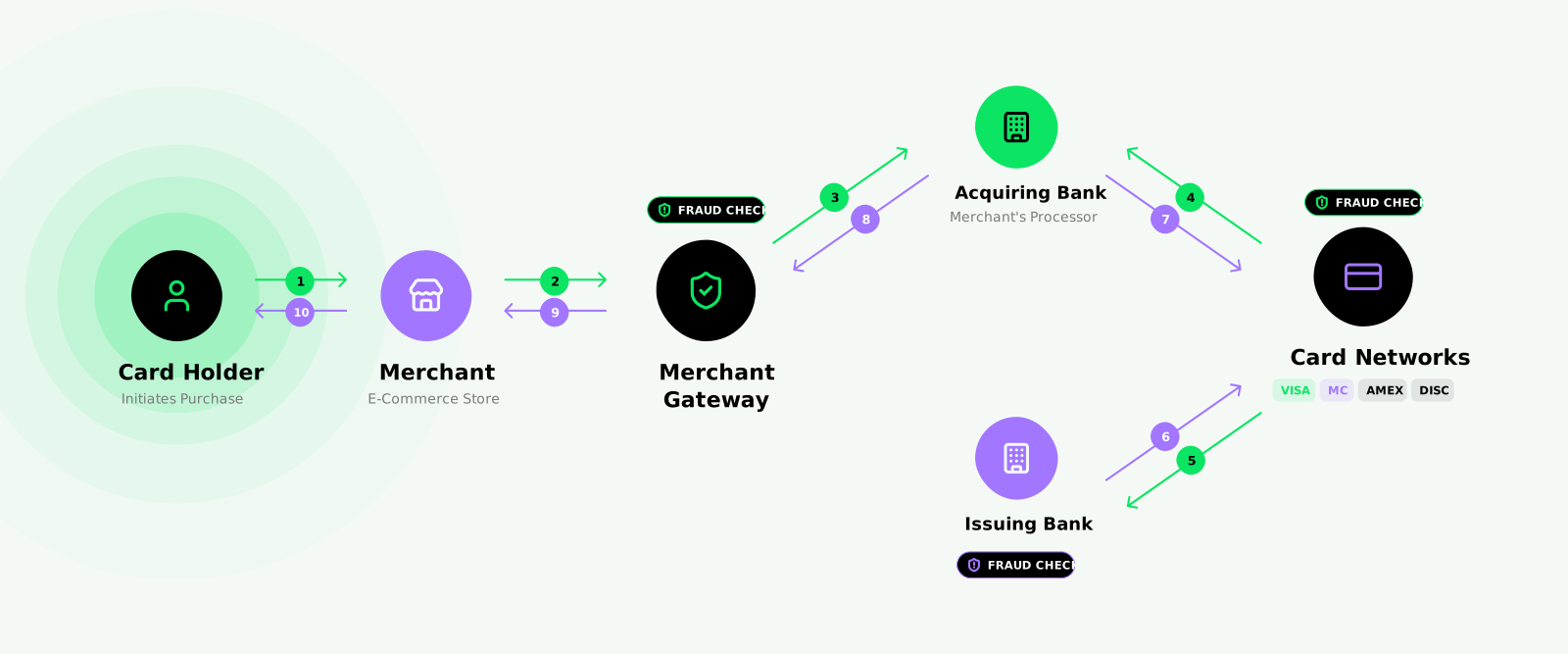
A traditional payment begins when a business instructs its bank to send money to a foreign beneficiary. The bank checks the account balance, beneficiary details, payment purpose and compliance information before submitting the instruction.
SWIFT generally carries the payment message between financial institutions, while the money itself is settled through accounts held by banks. When the sender’s bank has no direct relationship with the recipient’s bank, the payment may pass through one or more correspondent banks.
Each institution performs its own checks and may deduct fees, request more information or convert the payment into another currency. A transfer from one market to another may therefore involve several account movements before the recipient receives the funds.
SWIFT reports that 75% of payments sent through its network reach the beneficiary bank within ten minutes and more than 90% reach it within one hour. However, this measurement covers the time taken to reach the beneficiary bank. Local processing, compliance checks, account restrictions and crediting procedures can extend the time before the supplier gains access to the money.
Why international B2B payments fail
A payment failure can occur at any stage between initiation and final crediting. Some transfers are rejected immediately, while others remain pending until a bank completes an investigation.
1. Incorrect beneficiary information
Errors in names, account numbers, bank identifiers, addresses and payment references remain a common cause of delay. Even a misplaced digit or different spelling of a company name can trigger a rejection or manual review.
SWIFT identifies incorrect payee information as the most common cause of cross-border payment delays. Automated beneficiary verification can catch many of these errors before funds leave the sender’s account.
2. Compliance and transaction-monitoring checks
Banks and payment providers screen international payments against sanctions lists, AML rules, internal risk policies and jurisdiction restrictions. A transaction may require further review when information is incomplete, the payment pattern appears unusual or one of the companies operates in a higher-risk sector.
Correspondent banks can repeat these controls at several points in the chain. Sequential checks increase processing time and create different outcomes because each institution applies its own risk controls.
FATF updated Recommendation 16 in 2025 to improve the quality and consistency of information accompanying cross-border payments. The changes are intended to strengthen fraud prevention and financial-crime detection, while placing further importance on accurate sender and beneficiary data.
3. Currency conversion issues
FX conversion can cause failures when a bank does not support the requested currency, lacks sufficient liquidity or receives inconsistent instructions about who should perform the conversion.
Several conversions may also reduce the final amount. A payment could move from the sender’s currency into a major settlement currency and then into the recipient’s local currency. Each conversion introduces an exchange-rate spread and possible fees.
4. Banking restrictions and sanctions
A bank may reject a payment because of restrictions connected to the sender, recipient, jurisdiction, industry or transaction purpose. Problems can also arise when an intermediary bank has a more restrictive policy than the banks at either end.
A payment can therefore satisfy the sender’s bank while still being stopped later in the chain.
5. Correspondent banking failures
Correspondent banking gives financial institutions access to countries and currencies where they lack a direct presence. It also creates reliance on several organisations with separate operating hours, systems and risk policies.
The European Central Bank reported in 2026 that the global provision of correspondent banking services had declined by around 20% compared with the mid-2000s. Fewer relationships can increase concentration, raise costs and leave some payment corridors with limited coverage.
6. Payment routing and technical errors
Banks may route a transfer through an unsuitable intermediary or use outdated bank details. Formatting differences between payment systems can remove or alter important information, leading to repair requests.
Manual data entry adds further risk. Finance teams may copy information from invoices into banking portals and then enter the same transaction into accounting software. Every repeated step creates another opportunity for error.
7. Time zones and banking hours
International payments often depend on local clearing windows, currency cut-off times and public holidays. A payment initiated late on Friday in Europe may reach an Asian bank after its operating day has ended, delaying further processing until the following business day.
These timing constraints also affect liquidity. Treasury teams may need to fund several accounts in advance because money cannot always reach the required market when it is needed.
The hidden costs of failed international payments
The visible cost of a failed transfer may include a rejection fee, investigation charge or second payment fee. The commercial cost can be considerably higher.
A supplier awaiting payment may delay production or release of goods. A company may need to use emergency funding to protect a shipment, while finance employees spend hours contacting banks and tracing the transfer.
Failed payments also complicate reconciliation. The amount debited from the sender may differ from the amount returned after intermediary fees and FX conversion. Teams must then match several entries to the original invoice and explain the difference.
Repeated delays can weaken supplier relationships and affect future commercial terms. Global suppliers may request advance payment, higher deposits or shorter credit periods when they lack confidence in the buyer’s payment process.
Challenges beyond banks and payment providers
Changing providers can improve pricing or access to certain currencies, although the main weaknesses often originate deeper within the payment process.
International payments connect domestic banking systems, messaging standards, compliance rules and settlement arrangements. A provider may offer a modern interface while relying on the same correspondent network as its competitors.
Limited tracking creates another problem. A business may see that a payment has left its account without knowing which institution currently holds it, which fee has been deducted or when the beneficiary will receive it.
Fragmented records add operational work. Payment instructions may exist in an enterprise resource planning system, bank portal, email chain and accounting platform. Slow reconciliation then limits the treasury team’s view of cash positions and outstanding obligations.
How blockchain improves international B2B payments
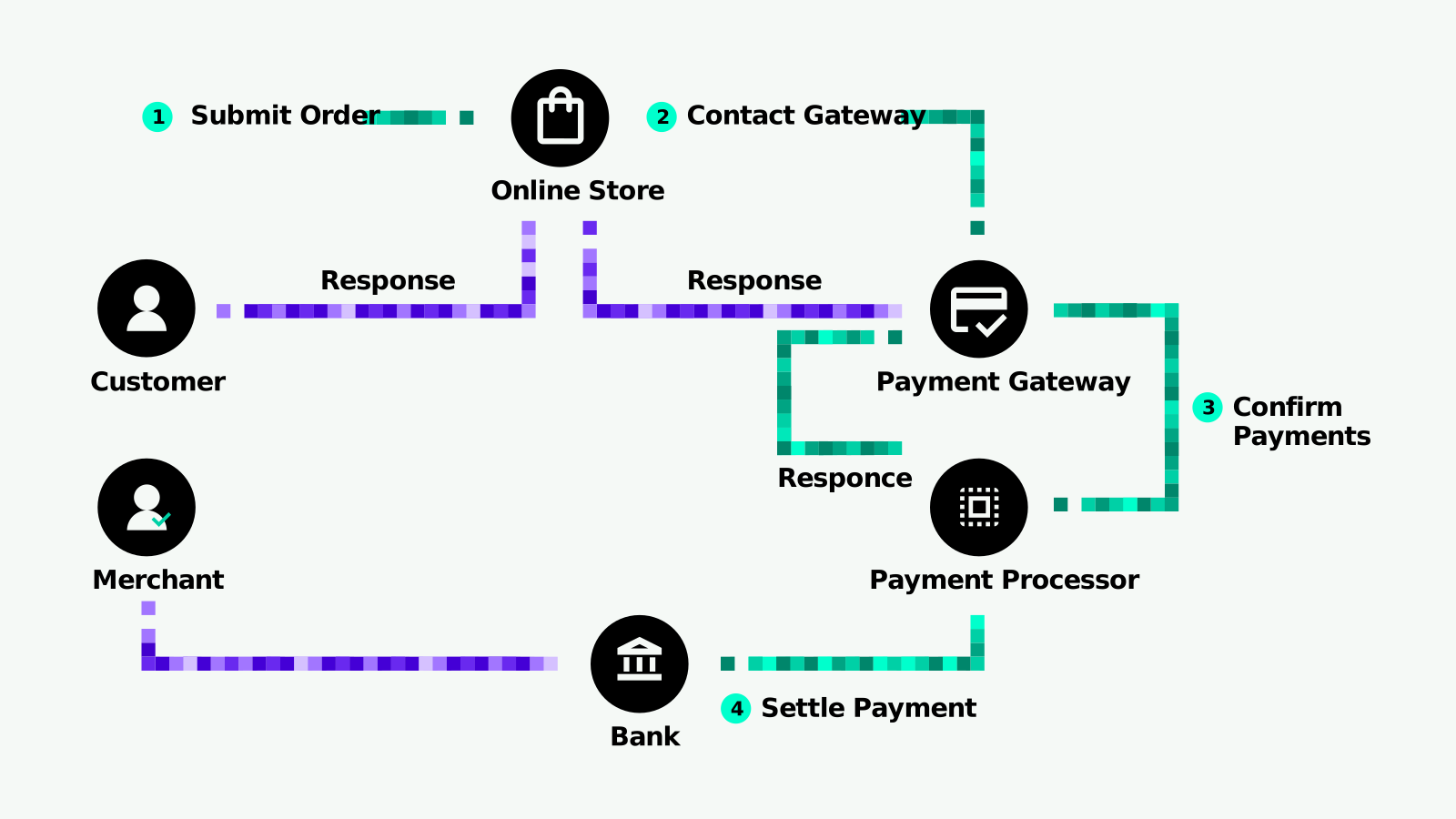
Blockchain payments can transfer value between approved wallets through a shared transaction record. The sender and recipient can track the transaction using the same data rather than requesting updates from several intermediaries.
Settlement can take place within minutes, depending on the selected network and its current conditions. Transactions can also operate continuously across weekends and public holidays.
This model can reduce settlement risk because the recipient can confirm when the assets arrive and when the transfer becomes final. Companies can connect payment data to internal systems through APIs, supporting payment automation and faster reconciliation.
Blockchain still requires careful implementation. Businesses need wallet controls, transaction monitoring, access management and procedures for converting digital assets into fiat currencies.
Stablecoins and crypto for international business payments
Stablecoins such as USDT and USDC combine blockchain transfer capabilities with a value designed to track a reference currency, usually the US dollar. Businesses can use them to pay overseas suppliers, fund foreign subsidiaries or transfer liquidity between operating accounts.
McKinsey and Artemis estimate the stablecoin market dynamics in 2025:
- $390B — estimated total stablecoin payment volume.
- $226B — B2B stablecoin payment volume.
- 60% — share of total stablecoin payment volume from B2B transactions.
- 733% — B2B stablecoin payment growth in 2025.
Stablecoins can help companies reduce dependence on banking cut-off times and maintain liquidity across several markets. A business can hold a dollar-linked asset, send it at any hour and let the recipient retain it or convert it into local currency.
Using one settlement asset can also reduce the number of FX conversions. The commercial invoice may remain denominated in dollars while the stablecoin carries the value between the companies.
International payment reliability depends on the complete route between the sender and recipient. Businesses gain greater control when they can verify payment details, track transfers in real time and choose between fiat and blockchain settlement according to the market, currency and supplier involved.

Businesses considering this approach can use a compliant provider to accept crypto payments, convert selected assets and organise settlement according to their operational requirements. A dedicated crypto wallet for business can also support supplier payments, treasury transfers and management of company funds.
How businesses can reduce payment failures
Companies can improve payment certainty by strengthening the process before and after each transfer.
- Beneficiary information should be verified automatically where possible, including the account holder’s name, account status, bank identifier and supported currency. Finance teams should also store approved supplier details centrally rather than copying them from individual invoices.
- Businesses can diversify their payment channels across bank transfers, local payment systems and blockchain-based options. This allows treasury teams to choose a route according to urgency, currency, cost and destination.
- Payment automation can connect invoices, approval processes, transaction data and accounting records. Automated reconciliation then identifies completed payments, deductions and exceptions without requiring employees to compare each entry manually.
- Stablecoin settlements can serve suppliers and regions where bank transfers remain slow or unpredictable. The company should first confirm local regulations, counterparty readiness, accounting treatment and conversion options.
Choosing the right international B2B payment solution
An effective international payment solution should match the company’s currencies, markets and transaction frequency. Key areas to assess include:
- Settlement speed and transaction finality;
- Supported fiat currencies and digital assets;
- Compliance and transaction-monitoring capabilities;
- Payment status tracking;
- Fee and FX transparency;
- API integrations;
- Reconciliation and reporting;
- Wallet and account security;
- Liquidity and conversion options;
- Support for global operations.
Providers should explain the complete payment route, including any banking partners, intermediaries and conversion stages. Businesses should also understand how exceptions are handled when a transaction requires investigation.
CryptoProcessing provides blockchain payments and business wallet services designed to connect digital-asset transactions with company financial operations.
The future of international B2B payments
Global business payments are developing around a combination of faster banking systems, blockchain settlement and stablecoins. Financial institutions are also experimenting with tokenised deposits, shared ledgers and links between domestic instant-payment networks.
Visa estimated that cross-border payment flows reached approximately $208 trillion in 2025 and could exceed $320 trillion by 2032. This volume creates a large commercial incentive to improve liquidity use, settlement times and transparency.
Many companies will adopt hybrid arrangements combining fiat and crypto. Banks may remain suitable for domestic payments and established corridors, while stablecoins support time-sensitive supplier payments, treasury transfers and markets with limited correspondent coverage.
Greater payment certainty will come from accurate data, automated compliance, real-time tracking and access to several settlement methods through one financial process.
Conclusion
International B2B payments fail because each transfer can depend on several institutions, currencies, regulatory checks and technical systems. Incorrect beneficiary details, limited correspondent coverage, payment routing errors and banking hours can turn a standard invoice payment into a lengthy investigation.
Blockchain and stablecoins give businesses additional ways to transfer value, track settlement and manage liquidity across borders. Their value becomes strongest when combined with compliance controls, secure custody, automation and reliable conversion services.
Companies that modernise their payment operations can reduce delays, protect supplier relationships and gain greater control over global financial operations.
FAQ
Why do international B2B payments fail?
Common causes include incorrect beneficiary information, compliance reviews, unsupported currencies, sanctions restrictions, correspondent banking problems, routing errors and missing payment data. Failures can occur at the sender’s bank, an intermediary or the beneficiary’s bank.
How long do international business payments take?
Many SWIFT payment messages reach the beneficiary bank within minutes or hours, although final access to the funds may take longer. Local clearing, compliance checks, time zones, currency conversion and bank processing can extend the total time to several business days.
Can blockchain reduce payment failures?
Blockchain can reduce failures linked to correspondent routing, restricted banking hours and limited transaction visibility. Businesses still need accurate wallet details, compliance screening, secure access controls and reliable conversion arrangements.
Are stablecoins suitable for B2B transactions?
Stablecoins can support supplier payments, treasury transfers, contractor payments and settlements between corporate entities. Suitability depends on local regulation, the counterparties involved, the chosen stablecoin, network fees, liquidity and the company’s accounting procedures.